


You've got a CRM, an email platform, HR software, accounting tools, shared drives, chat apps, and a few personal accounts holding customer information. Then a data subject access request arrives. Suddenly, “we have a privacy policy” doesn't help you find every record, prove who accessed it, or show when consent was withdrawn.
That's why GDPR compliance software should be treated as risk-control infrastructure, not a folder of policy templates. The right system connects customer, employee, supplier, consent, access, incident, and retention data into an evidence trail an SME can use during an audit.
Table of Contents
- Why GDPR Tools Matter More Than Ever for Small Businesses
- Core Capabilities Every GDPR Compliance Software Should Cover
- Dedicated GDPR Tools vs All-in-One ERP Modules
- How to Evaluate GDPR Compliance Software for Your SME
- Mapping GDPR Obligations to Daily Operations
- Why Consolidation Beats a Patchwork Stack
- Choosing the Right Path for Your SME
Why GDPR Tools Matter More Than Ever for Small Businesses
A 22-person SaaS company in Rotterdam receives a data subject access request. The founder assumes the response will be straightforward. The customer's details are in Intercom, but a support manager also has them in personal Gmail, two Notion pages contain copied notes, and a CRM export from 2021 sits in a shared folder.
Nobody has deliberately ignored GDPR. The company grew through small decisions. A new tool solved a short-term problem. A contractor created a spreadsheet. A sales representative exported contacts for a campaign. Over time, the business lost a reliable picture of where personal data lived.
That's the moment many founders discover the difference between documented intent and operational evidence. A privacy policy can explain what you aim to do. It can't prove which systems contain a person's data, whether access was limited, or whether an old export was deleted.
Enforcement creates recurring exposure
The GDPR became applicable on 25 May 2018, and enforcement pressure has continued to shape demand for software that manages consent, records, audits, and breach readiness. Supervisory authorities across Europe issued about EUR 1.2 billion in fines during 2024, while the cumulative total since the GDPR became applicable reached roughly EUR 7.1 billion by January 2026 across the jurisdictions surveyed by DLA Piper's GDPR fines and data breach survey.
The long-running Enforcement Tracker database also recorded 3,206 cases and EUR 6.31 billion in fines across 32 countries over nine years, with the largest single fine reaching EUR 1.2 billion. Those figures don't predict what will happen to your company, but they make one point clear. Regulatory exposure is continuous, not a one-time event.
The standard ceiling for the most serious GDPR infringements is €20 million or 4% of worldwide annual turnover from the preceding financial year, whichever is higher, as explained in the GDPR fines and penalties guidance. An SME may never face that maximum, but weak consent records, unlawful processing, or poor rights handling can still create an expensive and disruptive investigation.
SaaS growth makes evidence harder to assemble
An SME often works across 8 to 15 disconnected apps, including CRM, billing, support, marketing, HR, payroll, project management, storage, and communication systems. Each additional system can introduce another processor contract, user permission, export, retention rule, and integration to review.
Manual evidence collection fails under pressure because people remember processes differently. One employee may search the CRM, another may inspect email, and nobody may know whether a backup still contains the record. By the time the company assembles screenshots and spreadsheets, the evidence may be incomplete or impossible to reconcile.
Practical rule: If your team can't show what happened, who did it, and when it happened, the control isn't audit-ready.
GDPR compliance software gives owners a way to turn scattered activity into managed controls. It should help you identify data, enforce access, capture consent, respond to rights requests, document incidents, and export evidence. Without that systemization, audit readiness becomes a coin flip.
Core Capabilities Every GDPR Compliance Software Should Cover
A serious platform needs to connect legal obligations to actions inside the business. Cookie banners and policy generators have a place, but they don't solve the operational problem if customer records, employee files, supplier details, and backup copies remain disconnected.
The following capabilities are the baseline I'd use when reviewing a platform.
The capability map
| Capability | GDPR Requirement | What to Look For |
|---|---|---|
| Data mapping and records of processing | Article 30 requires controllers and, where applicable, processors to maintain records of processing activities | A living inventory connected to real systems, purposes, categories, owners, retention, and processors |
| Consent management | Consent must be traceable and withdrawable where consent is the lawful basis | Granular purpose-level opt-ins, withdrawal handling, timestamps, and proof of the notice shown |
| Role-based access control | Security measures must limit access to personal data appropriately | Role-specific permissions, separation of duties, export restrictions, and logged administrative access |
| Audit trails | Accountability requires evidence of how controls operate | Tamper-resistant records showing who changed what, when, and why, with export options |
| Breach response | Article 33 requires notification without undue delay and, where feasible, within 72 hours after awareness | Incident timestamps, owners, escalation paths, approval history, evidence attachments, and report generation |
| Data subject rights | GDPR rights include access, erasure, rectification, restriction, and portability | Search across connected modules, task ownership, status tracking, deletion checks, and response records |
| Retention and deletion | Storage limitation requires organizations to avoid keeping data longer than necessary | Rules by record type, deletion workflows, exception handling, and backup reconciliation |
| Vendor and transfer oversight | Controller and processor relationships and international transfers need documented governance | Supplier registers, contracts, transfer locations, subprocessors, risk reviews, and renewal reminders |
Data residency starts with the hosting jurisdiction. Ask whether production data is hosted in Frankfurt, Dublin, or another named location, then check the contract and backup architecture. An EU sales office doesn't prove EU hosting, and a vague statement about “global infrastructure” isn't enough for a risk review.
Consent records need context. A timestamp alone won't tell you what a person agreed to. The platform should retain the purpose, wording or notice version, channel, source, and withdrawal event. If a marketing intern can export the full customer table just because the CRM uses a shared admin account, the system has already failed its accountability test.
Audit trails must explain change. A screenshot can show the current state. An audit log should show the previous value, the new value, the user, the time, and the reason where relevant. That distinction matters when someone asks why a retention rule changed or who approved access to a sensitive record.
Database reality matters
The database layer is where many attractive compliance products become weak. Deletion can fail across relational schemas, backups can preserve supposedly erased records, and logging can conflict with erasure obligations. Recent analysis of database GDPR audit failures identifies internal data classification and automated deletion as persistent weaknesses.
Buyers should also test technical performance, not just policy coverage. The open-source GDPRbench framework evaluates database-oriented readiness through correctness against GDPR workloads, response time for GDPR queries, and storage-space overhead.
If a vendor can't demonstrate how its system handles linked records, backups, and deletion evidence, keep looking. A polished dashboard won't compensate for a broken data lifecycle.
For teams comparing adjacent workflow options, Kickstarter Kickstart 1 is listed as a one-time €79 package with AI assistants, 50 credits per month, planning and time tracking, a communication module, and Canva Studio. Those features don't replace a full privacy program, so evaluate them separately from GDPR control coverage.
Dedicated GDPR Tools vs All-in-One ERP Modules
Dedicated privacy tools and all-in-one ERP modules solve different problems. The first category goes deep into privacy administration. The second keeps compliance controls close to the operational records that create the evidence.
Dedicated products such as OneTrust, Securys, and Cookiebot can be strong choices for specialist work. They commonly focus on consent, DPIA templates, policy libraries, vendor questionnaires, data mapping, and DPA repositories. A regulated healthtech startup processing sensitive information may need that legal and assessment depth, particularly when privacy specialists manage a complex program.
The weakness is separation. If the dedicated tool says a supplier was approved, but procurement stores the contract elsewhere and finance pays invoices through another system, an auditor still has to connect the dots. The company may have excellent documentation and weak visibility into what employees do.
Where dedicated platforms win
Dedicated tools are usually better for:
- Legal documentation: Policy libraries, assessment templates, notices, and structured questionnaires.
- Privacy specialist workflows: DPIAs, vendor reviews, consent governance, and rights-request operations.
- Complex programs: Multiple jurisdictions, specialist privacy teams, and mature governance processes.
They're less convincing when the SME expects a separate privacy dashboard to enforce access inside the CRM, finance system, HR module, and production environment.
Where ERP modules win
An ERP-based approach treats compliance as part of normal work. A customer record, sales order, invoice, employee file, and supplier relationship sit within the same operational model. A permission change can be logged where the data is held, rather than copied into a second system later.
A B2B services firm handling standard commercial data may benefit from this consolidation. It can reduce duplicated administration and remove several standalone subscriptions, provided the ERP offers genuine consent controls, role-based access, retention workflows, and evidence exports.
| Dimension | Dedicated GDPR Tool | All-in-One ERP Module |
|---|---|---|
| Legal templates | Usually deeper | Often more limited |
| Operational evidence | May depend on integrations | Captured closer to the source |
| DPIA and vendor questionnaires | Typically strong | May require configuration |
| Access enforcement | Often indirect | Can operate within business roles |
| Data mapping | Broad if integrations are mature | Strong for native modules |
| Implementation | Faster for a narrow privacy scope | More involved because operations change |
| Best fit | Specialist privacy governance | SMEs seeking one operational source of truth |
Independent comparisons reinforce the practical point that no single tool covers the entire stack. Teams often combine consent management, DSAR automation, data mapping, security, encryption, and compliance automation, so this comparison of GDPR tools is useful when testing integration breadth rather than checking isolated features.
My view is simple. Dedicated tools win on privacy depth. ERP modules win on evidence continuity. Choose based on where your biggest failure risk sits.
How to Evaluate GDPR Compliance Software for Your SME
Don't buy from a polished demo. Make the vendor prove that the platform can handle your real data, your actual permissions, and an uncomfortable rights request.
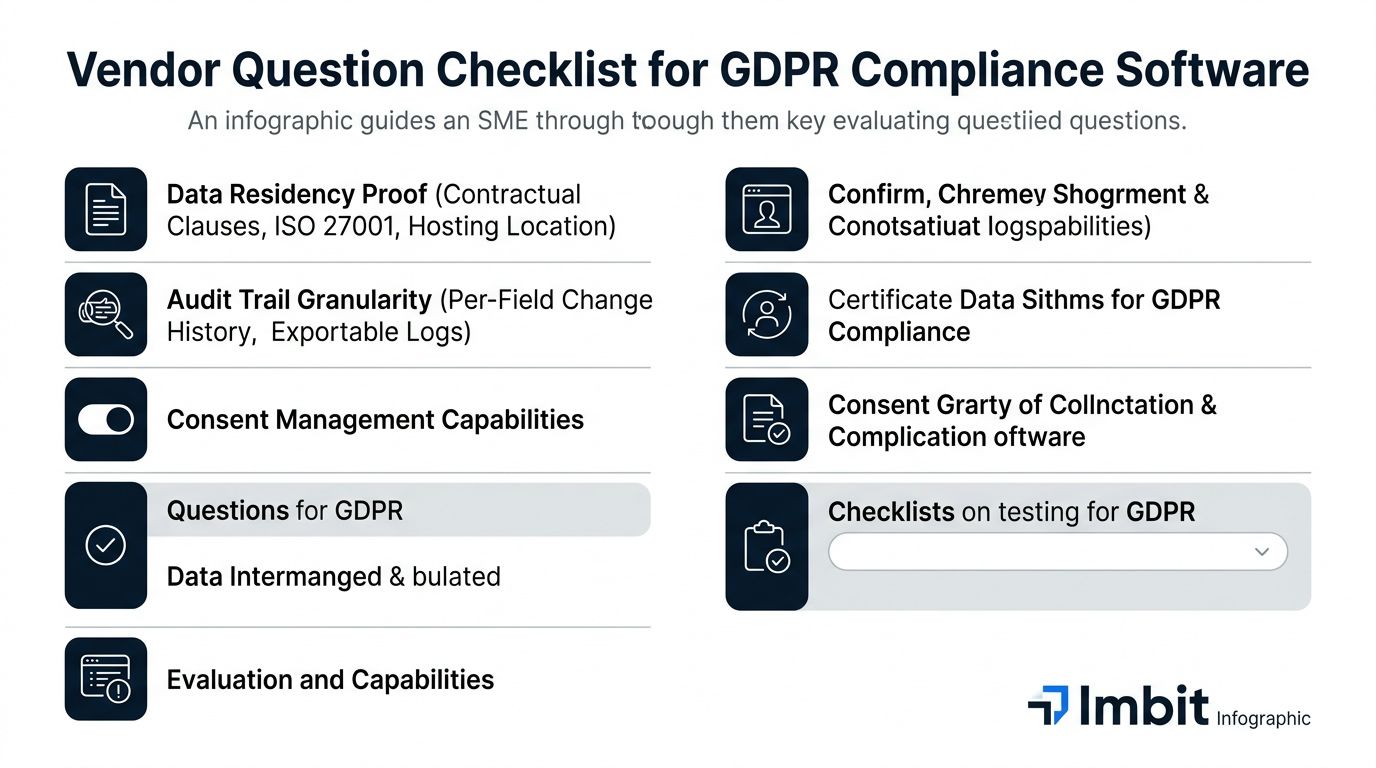
Start with five questions:
- Where is production data hosted? Ask for the hosting location, contractual clauses, backup locations, and relevant security certifications such as ISO 27001.
- How granular are the audit logs? Require per-field change history, user identity, timestamps, reasons, and machine-readable exports.
- How does consent work? Test separate opt-ins by purpose, withdrawal, notice versions, and evidence retrieval.
- Can the team run a breach drill? Start an incident and see whether the system records awareness time, assigns an owner, escalates the issue, and supports the Article 33 clock.
- Can you leave cleanly? Request data portability in a documented, machine-readable format before signing.
Test integration depth, not screenshots
A platform that depends on manual CSV uploads will drift quickly. Ask whether it reads live from your CRM, HR, finance, support, and marketing systems, or whether someone must repeatedly export and reconcile files.
Run a paid pilot with a real, controlled data subject access request. Time the process from identity verification through discovery, review, approval, response, and evidence export. Then test erasure across linked records and ask what happens to backups.
Reject obvious red flags
Be cautious if the vendor offers:
- Unclear residency: US-only hosting with vague Standard Contractual Clause language or no backup explanation.
- Weak consent: One broad marketing toggle instead of separate purpose-level choices.
- Shared administration: Generic admin accounts that make individual accountability impossible.
- Template dependence: Policy documents without connected records or enforcement.
- No exit path: Proprietary exports that leave your evidence trapped in the platform.
Score each product against data residency, audit evidence, integration depth, rights handling, breach response, usability, and total cost of ownership over a three-year horizon. A lower subscription price isn't lower risk if your staff must keep reconciling spreadsheets.
Mapping GDPR Obligations to Daily Operations
Compliance works best when employees encounter it inside the process they already follow. A sales representative shouldn't need to become a privacy lawyer to record lawful purpose. A warehouse manager should be able to give a seasonal worker the minimum access needed without exposing the entire employee or customer database.
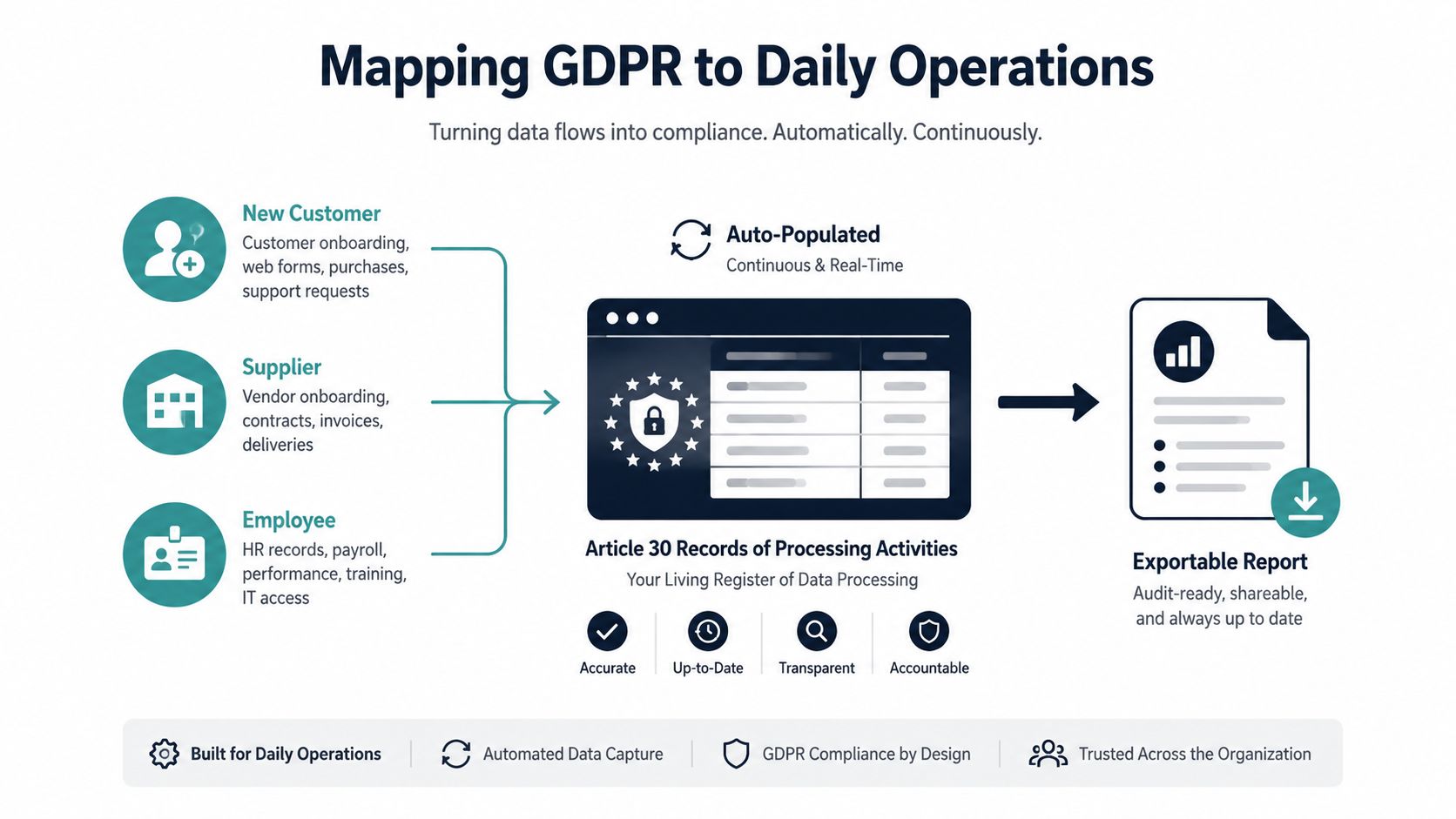
Article 30 is a good example. The Article 30 GDPR text requires controllers and, where applicable, processors to keep records of processing activities. The small-enterprise exemption is narrow. It doesn't apply where processing is regular, risky, or involves special-category or criminal-conviction data.
Turn records into a living register
In an EU-hosted ERP such as Zynthoro, the operating model should look like this:
- A new customer, supplier, or employee record enters the system.
- The relevant processing purpose, data category, owner, retention rule, and processor relationship are attached.
- Access permissions follow the person's role rather than a shared account.
- Changes create an evidence record.
- The compliance owner can export a current report without rebuilding it from separate spreadsheets.
Article 32 security decisions become concrete when a manager onboards a temporary worker. The manager can grant access to assigned warehouse tasks while restricting payroll, customer exports, and unrelated personnel records. If the permission changes later, the audit trail should show who approved it and when.
Make incidents and rights requests executable
Article 33 requires a controller to notify the competent supervisory authority without undue delay and, where feasible, within 72 hours after becoming aware of a personal data breach. The Article 33 requirement means the incident workflow should start when an employee flags a suspected exposure, not when the legal team eventually hears about it.
The platform should record the awareness time, assign an owner, attach evidence, route approvals, and support the authority report. The European Data Protection Board also explains that affected individuals must be informed without undue delay when a breach is likely to create a high risk, as set out in its SME guidance on data breaches.
Access and erasure requests should work similarly. A ticket should search connected modules, identify exceptions, route review, and retain the response evidence. New integrations should trigger a DPIA review where their processing creates additional risk, while supplier onboarding should connect contract, transfer, and vendor-risk information to procurement.
Why Consolidation Beats a Patchwork Stack
Every extra SaaS tool expands the compliance surface. You add another processor agreement, another administrator list, another access review, another retention setting, and another integration that can copy personal data into a place nobody remembers.
That cost is easy to miss because each subscription looks harmless in isolation. The audit problem appears later, when the owner must show a complete data map and explain why a customer's information appears in six systems but only four are covered by the deletion workflow.
One operating model creates better evidence
A consolidated ERP can bring records of processing, consent capture, permissions, operational changes, and audit trails closer together. That reduces the evidence hunt because employees create records in the same environment where the company manages customers, suppliers, finance, HR, and workflows.
This doesn't mean every SME should replace its entire stack tomorrow. Consolidation demands leadership commitment, process redesign, migration work, and user training. A 25-person services firm with simple operations may be comfortable with a focused privacy tool. A 50-person manufacturer serving EU customers usually has more to gain from connected controls across procurement, production, quality, inventory, finance, and customer records.
| Dimension | Patchwork Stack with 8 to 15 Tools | Consolidated EU-Hosted ERP |
|---|---|---|
| Data visibility | Split across vendors and exports | Centralized across native modules |
| Processor oversight | Many contracts and subprocessors | Fewer core relationships, still requires review |
| Access reviews | Repeated in each application | Managed through a connected role model |
| Audit evidence | Screenshots, exports, and reconciliation | Shared records and exportable history |
| Deletion handling | Depends on every integration | Easier to coordinate across native records |
| Rollout effort | Lower at first | Higher during migration and adoption |
| Long-term trade-off | Familiar but fragmented | More change, stronger continuity if configured well |
Cloud growth and integrated compliance workflows are converging, but buyers should inspect the architecture rather than trust the label. An “EU product” with a US-hosted backend doesn't solve residency concerns. Check production storage, backups, subprocessors, support access, and machine-readable evidence exports.
The consolidation thesis is strongest when compliance and operations share the same records. It's weakest when a platform merely adds a compliance tab beside disconnected data.
Choosing the Right Path for Your SME
Your stack and risk profile should determine the buying path.
A five-person bootstrapped team
If you run on spreadsheets and a CRM, a standalone GDPR platform may be the most practical starting point, especially when you have no internal IT capacity. Use it for consent records, policies, processor documentation, rights requests, and incident procedures.
Don't mistake templates for compliance, though. You still need to know where personal data lives and who can access it. A small team can keep the architecture simple, but it can't ignore evidence.
A 30-person growth company
A growth-stage company with customer data spread across cloud tools should evaluate an all-in-one ERP module such as Zynthoro alongside dedicated privacy products. Data residency, role-based access, and audit trails need to operate close to the records employees use every day.
Ask vendors:
- Can the platform map live data flows? Require connected evidence rather than periodic CSV uploads.
- Can managers enforce least-privilege access? Test a real sales, HR, finance, and temporary-worker scenario.
- Can the system export an audit package? Ask for records, logs, approvals, and incident documentation in machine-readable formats.
A 50-plus-person operation
If you're preparing for a documented audit or vendor due-diligence review, prioritize continuity over attractive templates. A dedicated tool may still add value for DPIAs, specialist assessments, and supplier questionnaires, but your operational platform should support the underlying access, retention, incident, and evidence controls.
Vendor risk deserves particular attention. A 2026 European compliance report found that only 36% of vendors in a portfolio received a risk assessment, highlighting the gap between software adoption and actual supplier oversight. Your platform should connect procurement to vendor reviews, transfers, subprocessors, and renewal decisions.
Two requirements are essential: an EU data center and machine-readable evidence exports. If your current stack can't support both, start replacing the most disconnected workflows first.
Zynthoro offers an EU-hosted workspace that connects finance, sales, HR, operations, communication, planning, and compliance controls, including role-based access and audit trails. Visit Zynthoro to assess whether consolidating your operational data can give your SME a clearer GDPR evidence trail.