


Your sales team sends the quote. Operations says the delivery date is fine. Finance spots the margin problem only after the customer has signed. That's the moment most SME owners realize the same thing, the issue wasn't speed, it was the way the business was pieced together with spreadsheets, email, and disconnected apps. A solid quote to cash process fixes that by tying the commercial promise to billing, cash collection, and revenue recognition, so bad deals don't slip through just because they moved quickly.
Table of Contents
- Why Your Current Sales Process Is Leaking Revenue
- The Seven Stages of Quote to Cash Explained
- Pre-Quote Decisioning Preventing Bad Deals Before They Exist
- How Quote to Cash Adapts to Recurring Revenue Models
- Automation Opportunities at Each Q2C Stage
- Implementing Quote to Cash with Zynthoro
- Your Next Steps to Streamline Revenue Operations
Why Your Current Sales Process Is Leaking Revenue
A lot of SMEs run quotes from one tool, orders from another, and invoices from a third. Sales works in the CRM, finance cleans up the paperwork later, and operations keeps a separate view of what can be delivered. By the time those threads meet, someone has already promised the wrong date, applied the wrong discount, or used old terms.
The damage usually shows up as manual rekeying, version confusion, and approval delays. A modern quote to cash process connects the CRM-side quote to ERP-side billing and recognition, which is exactly why it matters as an operations discipline, not just a sales task. One research summary cited in the brief reports that from sales opportunity creation to revenue recognition, 47 days elapsed on average, and only 12 of those days involved actual customer-facing selling, which is a sharp reminder that most of the cycle is operational rather than commercial. That source also frames Q2C as a workflow spanning quoting, order management, billing, payment collection, and revenue recognition, so it's a control point for cash flow, not just admin work. Quote-to-cash process overview
What breaks first
The first break is usually data continuity. Sales writes one version of the deal, operations reads another, and finance reconstructs the truth from attachments and emails.
Practical rule: if a rep has to ask three different people before sending a quote, the process is already leaking revenue.
The second break is visibility. Leaders see closed deals and month-end numbers, but they can't see lost quotes, blocked customers, or margin risk early enough to act. That's why the quote to cash process isn't just about moving faster, it's about seeing the commercial reality before it hardens into a bad contract.
The Seven Stages of Quote to Cash Explained
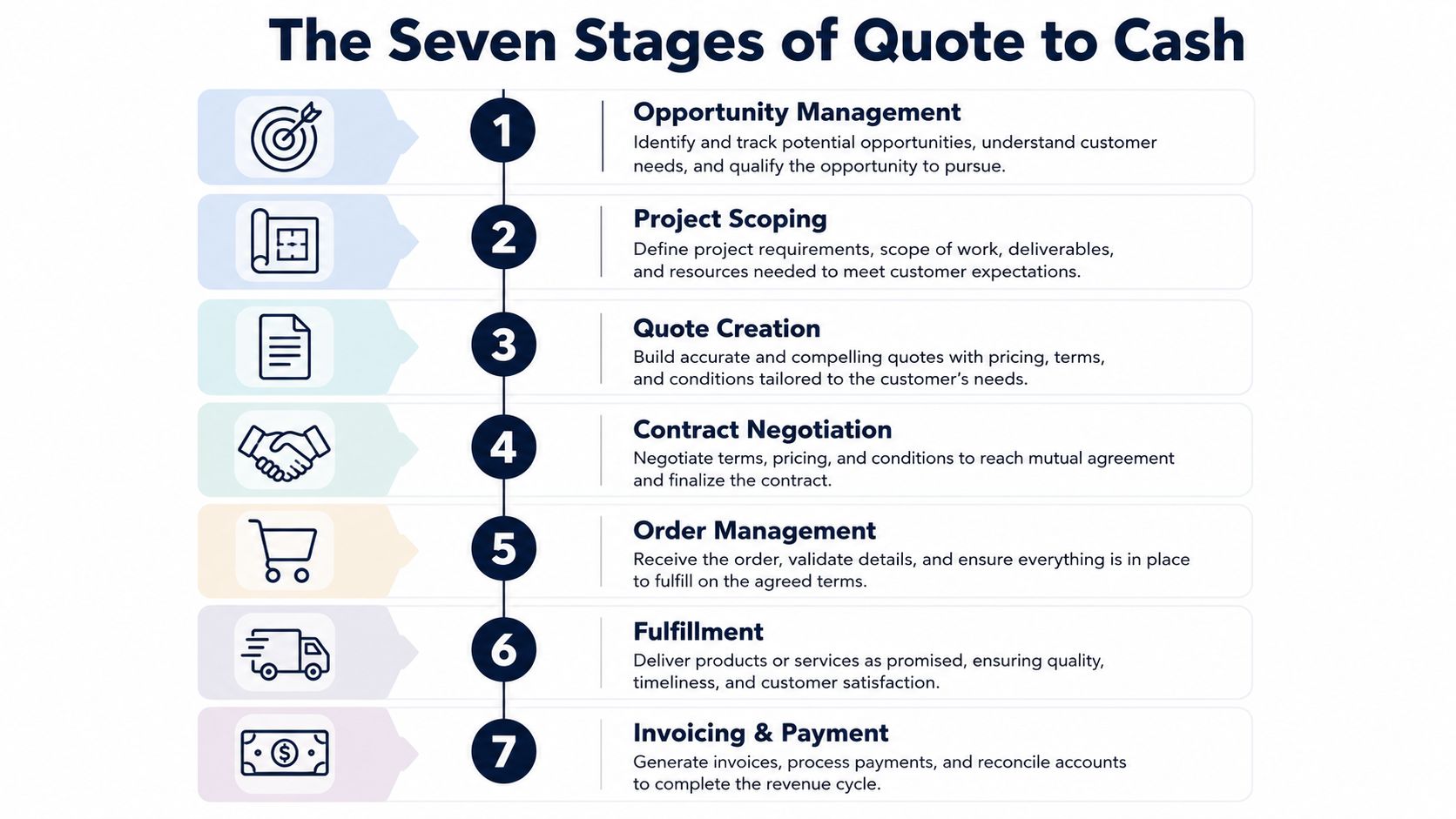
The cleanest way to understand the quote to cash process is to follow the handoff from opportunity to payment. Conga breaks it into configuration, pricing, quoting, contract creation, contract negotiation, contract execution, order fulfillment, billing, revenue recognition, and renewal, and that sequence fits both product and service businesses when the data stays connected. Conga's 10-step Q2C guide
Opportunity to contract
The cycle starts with opportunity management. A rep records the lead, the scope, and the likely close path. In manufacturing, that can mean a custom equipment opportunity with options, lead times, and special installation needs. In consulting, it may be a project brief with assumptions about staff time, milestones, and deliverables.
Then comes project scoping and quote creation. Good scoping turns the customer need into a structured, billable offer. The quote needs prices, terms, and any constraints that downstream teams can trust without retyping them. Conga notes that configuration and pricing shape the deal before the customer ever sees the document, because the wrong bundle or discount can hurt margin early. Tekst on quote-to-cash flow
Then comes contract negotiation and contract execution. This phase includes redlines, approval routing, and signature control. Tekst's seven-phase model makes the contract step and later dispute resolution explicit, which is useful because many SMEs still treat disputes as an exception rather than a normal operational stage.
From order to cash
Once the contract is signed, order management and fulfillment take over. A manufacturer uses the signed quote to trigger purchasing, production, and delivery. A consulting firm turns the accepted scope into assignment planning and time capture.
Billing comes next, then payment collection, then dispute handling if something does not match the customer's expectation. Planview's service-focused breakdown is useful here, because it ties opportunity management to scoping, time capture, billing structure, and revenue management in one flow. A small implementation agency can move from scoped work to time tracking and invoicing without rebuilding the record in another system. Planview's six-step Q2C guide
For SMEs, the lesson is simple. If a handoff is invisible, it is probably fragile.
Pre-Quote Decisioning Preventing Bad Deals Before They Exist
Many teams think the quote to cash process starts when the quote goes out. That's too late. The highest-value systems decide whether a deal should even be quoted in the first place, because a fast bad quote is still a bad quote.
A quote should reflect live inventory, current cost, credit exposure, and operational capacity before anyone sends it. One independent commentary in the brief argues that businesses often see invoicing and closed orders, but miss lost quotes, blocked customers, sellable availability, and margin data that should shape the winning price. That's the kind of gap that creates avoidable promise errors, especially in manufacturing and SME services where one wrong assumption can ripple through production, delivery, and cash flow. Pre-quote decisioning perspective
Where bad deals start
A rep promises 30-day delivery while production is booked for much longer. A discount gets approved on a complex configuration without anyone checking the cost stack. A customer with payment issues gets a generous contract because the sales team is chasing the close, not the risk profile.
The quote to cash process acts as a revenue quality control system. It doesn't just process the deal faster, it filters out weak deals before they hit the customer. That mindset matters for SMEs because one margin leak can be harder to absorb than a large enterprise would think.
Operational truth: a quote is not just a sales artifact, it's a commitment the whole business has to honor.
That's why Agency matters as a comparison point for multi-client teams. Its positioning around accounting, inventory, project management, and team structure shows how much friction appears when different functions don't share the same commercial data.
What good pre-quote control looks like
Good pre-quote control makes the salesperson slower for a moment and the business safer for the entire lifecycle. The rep sees whether the product is available, whether the margin still works, and whether the customer's terms fit the company's risk rules. The finance team gets fewer surprises later, and operations stops inheriting impossible promises.
That's the gain. The best quote to cash process prevents defects in revenue quality before the customer ever sees them.
How Quote to Cash Adapts to Recurring Revenue Models
Recurring revenue changes the shape of the process. A one-time sale ends at invoice and payment, but subscriptions, usage billing, and hybrid contracts keep moving after signature. McKinsey notes that as-a-service sales require a transformation because the business has to support faster, more continuous commercial motions, not one-off deals. McKinsey on as-a-service quote-to-cash
The operational shift is bigger than many owners expect. Contractions, amendments, renewals, and usage events all change the billing picture, and each one can expose a weak quote or a sloppy approval path. Subscription teams need quote to cash to handle those changes as part of the core process, because a static quote and a one-time invoice leave too much room for billing errors and revenue leakage.
Three examples that behave differently
A SaaS company might upgrade a customer mid-contract. That creates a new pricing event, a new billing rule, and a revenue recognition question. Sales has to know whether the upgrade is allowed under the original terms, and finance has to know how the change affects the ledger.
A consulting firm might bill time and materials with monthly caps. The quote sets the commercial boundaries, but actual billing depends on tracked effort, agreed limits, and whether the work still fits the approved scope. If those controls are loose, the team can sell work that looks profitable on paper and turn into margin drift later.
A manufacturer might lease equipment and bundle a service contract. That blends fulfillment, recurring billing, and contract management into one customer record, so the quote has to reflect what can be delivered and maintained over time. A disconnected process here usually shows up later as invoice disputes, service confusion, or contract language that no one can operationalize cleanly.
Kickstart 3 fits the broader pattern here because its finance, operations, project management, and marketing modules are built around connected business activity rather than isolated transactions. That matters when revenue keeps changing after the original quote, since the quote, order, service, and billing record all need to stay aligned as the customer relationship evolves.
Metrics that actually matter
For recurring models, the useful measures are quote turnaround time, order processing time, billing accuracy, time to revenue recognition, and renewal conversion rates. Those metrics show where the commercial motion slows down and where accounting starts to lose confidence in the numbers. They also help teams spot bad deal patterns early, such as quotes that are accepted quickly but create repeated billing corrections later.
The mistake many SMEs make is managing recurring revenue like a static sales pipeline. That works until the first amendment, first usage overage, or first renewal cycle exposes the gaps. A strong quote to cash process handles those events as normal operating traffic, and it also acts as a revenue quality check before the customer relationship turns into a repair job.
Automation Opportunities at Each Q2C Stage
Automation is useful, but only when it removes repeatable work and leaves judgment where humans still need to think. The best systems don't automate every decision. They automate the data movement, the template work, and the checks that people keep getting wrong.
What to automate first
- Quote generation: Pull products, services, and prices from a controlled catalog instead of building quotes from scratch.
- Approval workflows: Route discounts, special terms, and non-standard clauses to the right approver before the quote leaves the building.
- Contract templates: Pre-fill legal and commercial fields so the team isn't copying details into separate documents.
- Order creation: Turn accepted quotes into orders without rekeying line items.
- Invoice generation: Use delivery confirmation or milestone completion to create the invoice from the same source record.
- Payment reminders: Trigger follow-up sequences automatically when invoices age.
- Revenue recognition rules: Map contract terms into accounting logic so finance doesn't rebuild the story by hand.
That's the short version. The bigger point is that automation should replace the handoff, not the oversight. A rep can still approve a custom discount, but the system should keep the line items, terms, and customer details synchronized across the workflow.
Where automation pays back fastest
Document generation is usually the first win because it cuts duplicate entry and version confusion. Contract routing is another obvious win because it reduces the number of places a clause can drift out of sync. Billing automation helps too, especially when service delivery and invoicing happen on different dates.
The goal isn't to remove people from the quote to cash process. The goal is to keep people from spending time on copy, paste, chase, and correction.
Zynthoro is relevant here because its sales administration and invoicing modules can support the same end-to-end sequence, with embedded AI helping keep the steps connected instead of scattered across separate apps. That matters for SMEs that want one operational record rather than a stack of disconnected tools.
Automation won't fix bad pricing strategy. It will make bad pricing show up faster, which is usually the first honest signal a business needs.
Implementing Quote to Cash with Zynthoro
A practical rollout starts with the tools you already have, not with software shopping. Audit the current quote path, the contract path, the invoice path, and the payment follow-up path. Then map where people are retyping the same customer, product, and term data more than once.
From there, configure the workflow in Zynthoro around the connected modules that matter most for Q2C, Sales Administration, Invoicing & Finance, Project Management, Time Tracking, and Accounting. Zynthoro's published platform design emphasizes real-time data continuity, EU-hosted controls, and embedded AI in the workflow, which is exactly the kind of structure a fragmented SME stack usually lacks.
A rollout that doesn't stall
- Audit the current stack. List every spreadsheet, inbox, and app involved in quoting, approval, invoicing, and reconciliation.
- Map the handoffs. Identify where data gets copied, where approvals get lost, and where customers wait.
- Configure the core modules. Keep the first setup narrow, and connect sales, invoicing, and accounting before adding more complexity.
- Migrate live records carefully. Move active quotes, open invoices, and essential customer history first.
- Train the team on one flow. Sales should know what finance needs, and finance should know what operations sees.
- Measure the process. Watch quote turnaround time, invoice accuracy, and the number of manual corrections before expanding.
Zynthoro's AI-assisted quote generation, automated invoice sending and chasing, real-time ledger updates, and EU-ready compliance controls are useful only if they sit inside a process the team follows. That's why implementation discipline matters more than feature lists.
The common failure mode is trying to automate chaos. The better move is to standardize the deal path first, then let the system enforce it.
Your Next Steps to Streamline Revenue Operations
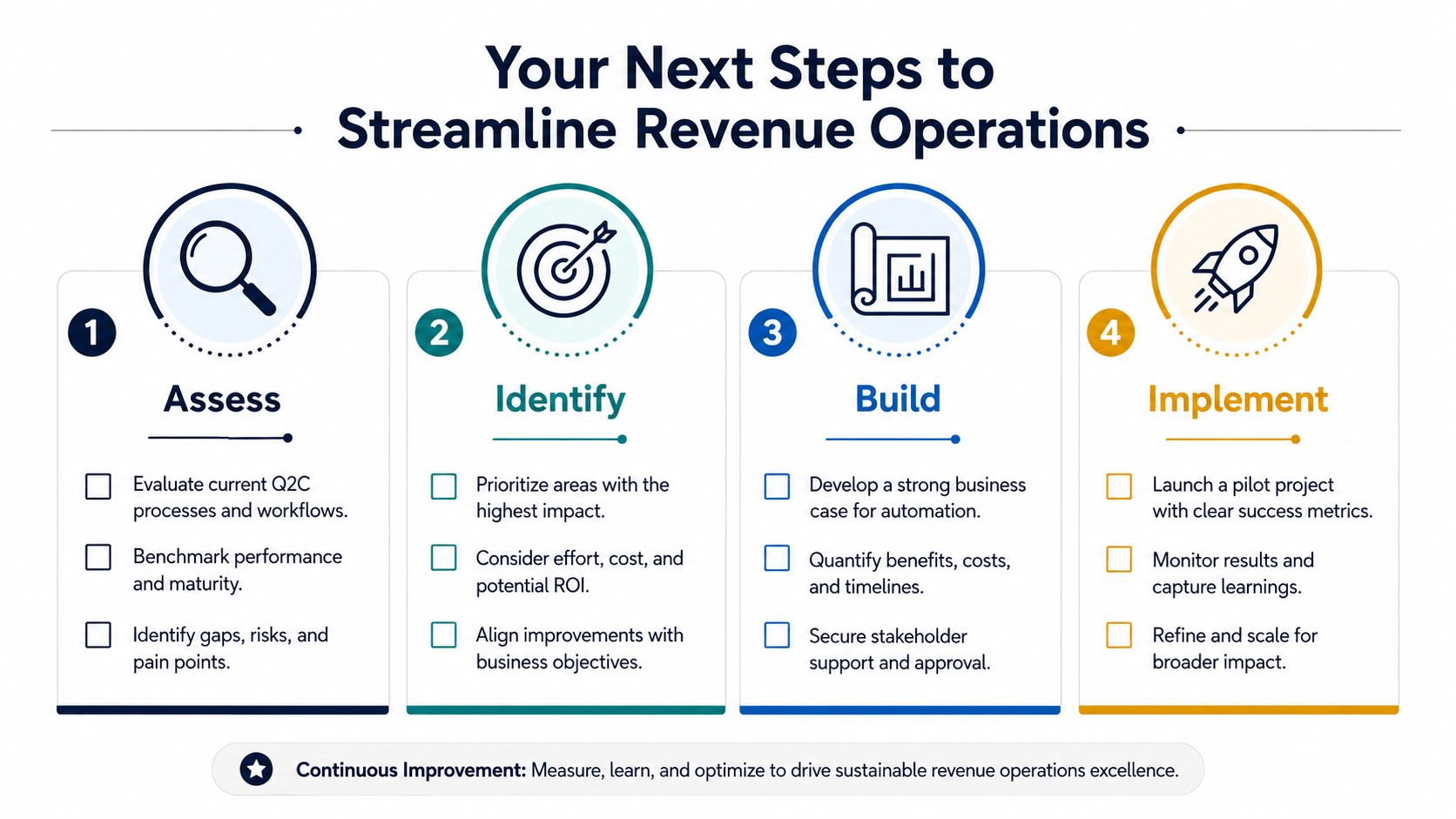
Start with a simple review of your current quote to cash process. Ask where quotes get stuck, where pricing drifts, where invoices get disputed, and where finance has to rebuild the deal from scratch. If the same customer data is touched in multiple places, you've already found a weak spot.
Then choose the biggest revenue leak, not the most visible annoyance. For some SMEs that's quote turnaround. For others it's order accuracy, dispute handling, or revenue recognition confidence. Build the business case around the work your team keeps repeating and the risk your company keeps absorbing.
A practical checklist
- Assess current maturity. Trace one deal from first quote to cash receipt.
- Identify the weakest handoff. Find the point where data gets lost or re-entered.
- Build the case. Show how one connected system reduces manual fixes and late surprises.
- Implement in a pilot. Start with one team or one offer type before rolling out widely.
Track quote turnaround time, order accuracy, invoice dispute rate, days sales outstanding, and revenue recognition accuracy before and after the change. Those measures tell you whether the process is getting cleaner, not just busier.
If you're replacing disconnected tools, don't wait for the perfect redesign. Choose one workflow, tighten it, and let the team prove the gain in daily use. Zynthoro gives SMEs a single place to run sales administration, invoicing, accounting, and project work without the usual silos.
If your team is still stitching quotes, approvals, invoices, and accounting together by hand, Zynthoro is built to replace that patchwork with one connected operating flow. Visit Zynthoro to see how its sales, finance, project, and accounting modules can support a cleaner quote to cash process for your business.