


At 9:14, a salesperson confirms a rush order. At 9:16, the warehouse is still looking at yesterday's stock figure. Finance enters the invoice manually around lunchtime, while operations reschedules production without seeing the customer promise. By mid-afternoon, the customer has a delivery date that no system fully supports.
This situation is common in small manufacturing and distribution businesses. The tools may work perfectly on their own, yet the business still suffers from missed margins, conflicting commitments, unnecessary credit holds, and hours spent comparing spreadsheets. Real-time data synchronization addresses the underlying continuity problem by keeping finance, sales, operations, inventory, and production connected as work happens.
Table of Contents
- When One Order Becomes Five Versions of the Truth
- Understanding Real-Time Data Synchronization
- Architecture Patterns That Keep Data Aligned
- How Continuity Works Across an SME
- Why Synchronization Matters for Small Businesses
- Reliability Risks and Common Pitfalls
- KPIs and Monitoring for Trusted Data
- Choose Continuity Without Adding Complexity
When One Order Becomes Five Versions of the Truth
The salesperson sees an available product quantity in the sales system and confirms the order. The warehouse checks its own application and finds less stock than expected. Someone then searches email for a recent receipt from a supplier, while another employee checks whether goods have already been reserved for a different customer.
The order has now become several competing records. Sales believes the customer has a confirmed delivery date. Inventory believes the order needs purchasing support. Operations sees a production change but not the reason behind it. Finance may pause the invoice because the customer account appears to be on credit hold, even though a payment has already been received.
None of these people necessarily made a careless decision. They acted on the information available in their separate tools. The core problem is that each system holds a local copy of the business, and those copies drift when updates move through manual entry, spreadsheets, email, or scheduled imports.
Practical rule: If employees must ask which spreadsheet is current, the business doesn't have a single operational truth.
Real-time data synchronization means that a change in one connected system is propagated to the others continuously. A confirmed order can update stock allocation, trigger a purchasing requirement, inform production planning, and prepare the relevant finance activity without someone retyping the same facts. Real-time ERP integration is generally understood as propagating changes within seconds, while batch synchronization uses scheduled intervals such as hourly or daily (ERP integration guidance from Stacksync).

The benefit isn't speed for its own sake. It's continuity. The same customer, product, quantity, price, payment status, and delivery commitment remain in context as the order moves through the business. That gives employees fewer records to reconcile and gives the owner a clearer answer when a customer asks, “Where is my order?”
Understanding Real-Time Data Synchronization
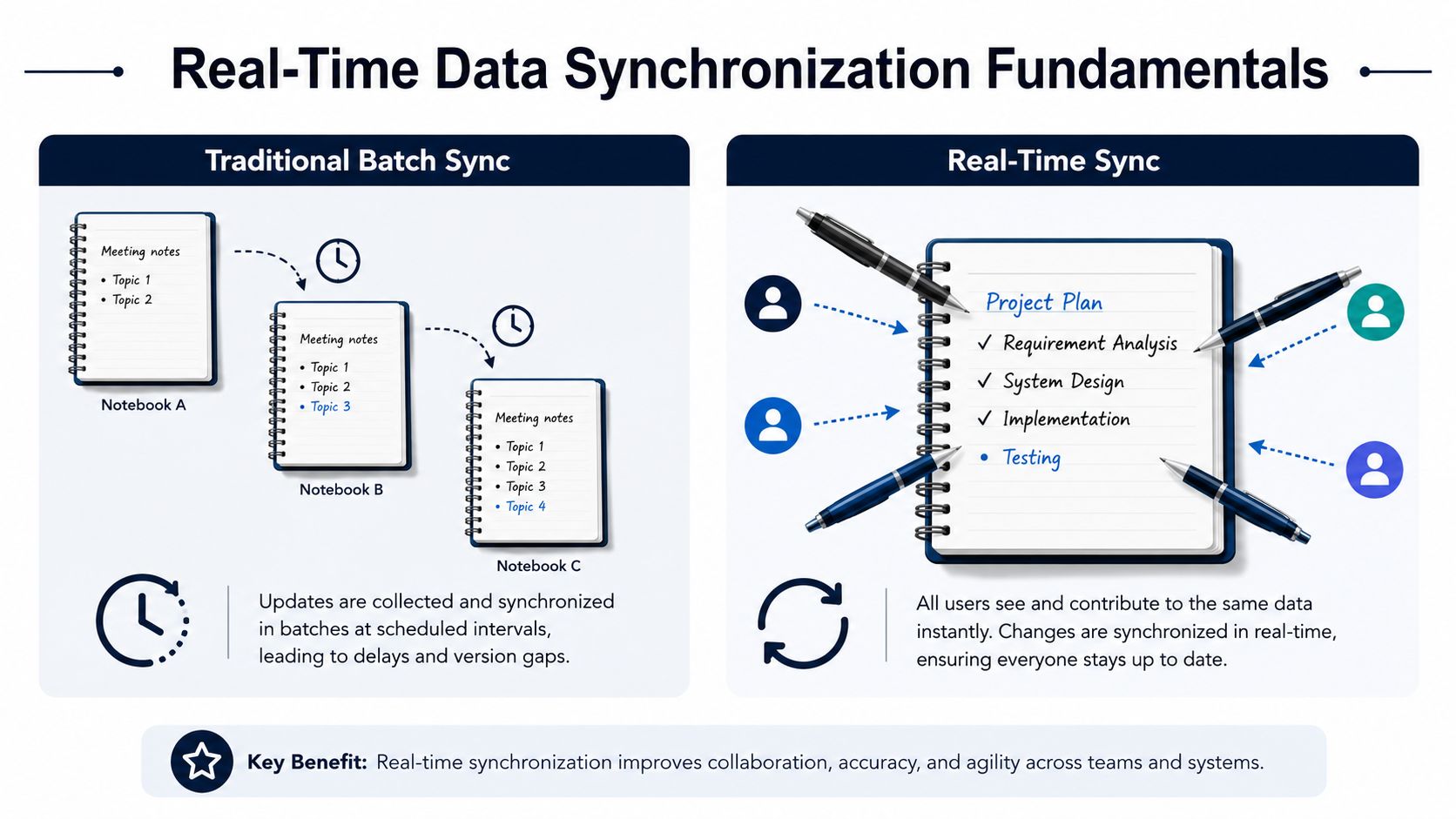
Think of a shared notebook on a worktable. Sales writes down a new order, inventory immediately sees the reservation, purchasing records the supplier requirement, and finance can follow the transaction. Nobody carries a private copy home and updates it later. Everyone works from the same changing record.
That's the basic idea behind real-time data synchronization. Connected systems continuously propagate business events, such as a new order, stock receipt, invoice, payment, or production update, so each relevant module reflects the same underlying facts within seconds rather than waiting for an overnight job. Real-time synchronization is particularly useful for workflows such as payments, stock updates, fraud checks, and ticket routing (practical real-time synchronization examples).
Batch synchronization follows a different rhythm. It gathers changes and transfers them together on a schedule. That can work for reports that don't need current information, but it creates an interval in which teams may act on stale data. If a batch job fails, the error can affect a larger group of changes and may not be noticed until someone checks the next report.
With continuous delivery, each event can be acknowledged, retried, isolated, or replayed closer to when it occurred. That narrows the error window and supports decisions that depend on current stock, customer status, or transaction activity. The right approach still depends on the workflow. A dashboard refresh may tolerate eventual consistency, while an invoice, payment posting, or inventory movement needs stricter alignment.
Freshness is not the same as consistency
Freshness asks, “How quickly does the change arrive?” Consistency asks, “Can different users receive conflicting answers while the change is moving through the system?”
For finance-critical records, such as invoices, payments, and stock movements, you should define strong controls around the accepted state before the next action is authorized. For lighter signals, such as a management dashboard or notification, eventual consistency may be reasonable if users understand that the display can briefly lag behind the source record.
A useful comparison of data synchronization platforms compared can help you assess delivery models, connectors, and operational safeguards. The important question isn't whether a product uses the phrase “real time.” Ask which business events move continuously, what happens when delivery fails, and how the platform prevents conflicting updates.
Architecture Patterns That Keep Data Aligned
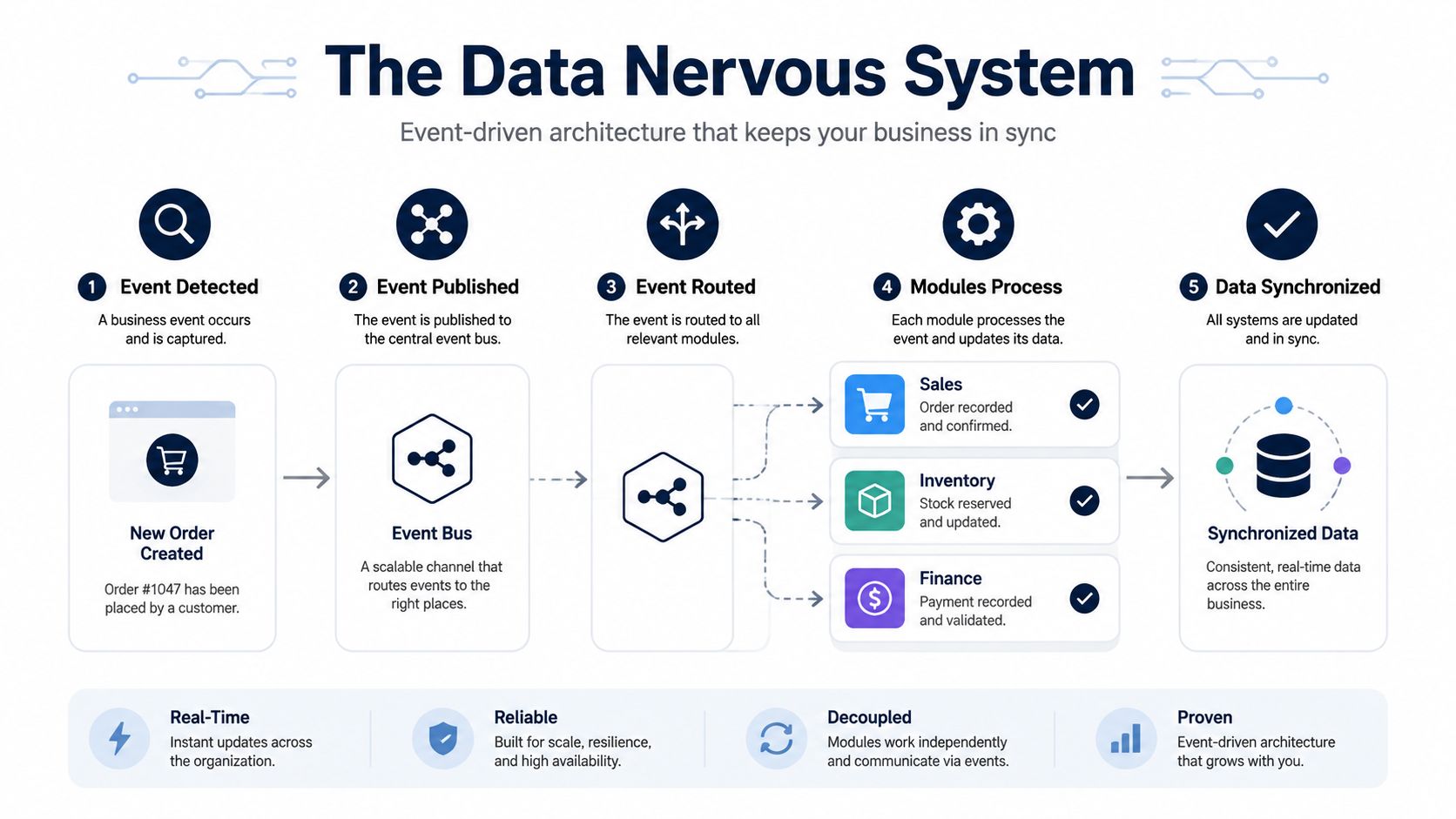
A dependable architecture behaves like a nervous system. It notices a business event, routes the signal to the right destinations, waits for each destination to process it, and records whether the action succeeded.
For an SME, the technical vocabulary matters less than the responsibilities behind it. A reliable implementation should include:
- A source of truth: Core records for customers, products, accounts, prices, and inventory need clear ownership.
- Shared identifiers: The same customer ID, product ID, order ID, and invoice ID must travel across modules.
- Event publishers: Systems publish create, update, and delete events instead of forcing every destination to repeatedly ask whether something changed.
- Durable queues: Events wait safely when a destination is unavailable or temporarily overloaded.
- Idempotent consumers: A duplicate message produces the same safe result instead of adding a second charge, reservation, or stock movement.
- Recovery controls: Retries, dead-letter handling, and replay allow teams to recover from errors without rebuilding the entire process.
Events create a dependable chain
Suppose a customer order is accepted. Sales publishes the order event. Inventory consumes it and reserves available units. If stock is insufficient, purchasing or production receives the next event. Finance receives the authorized commercial data and prepares the relevant posting or invoice workflow.
This is more resilient than building a separate point-to-point connection between every pair of applications. In a tightly coupled setup, one field change can break several integrations. In an event-driven design, modules subscribe to the events they need, while the business keeps a visible history of what happened.
Nightly file drops can still serve historical reporting or low-priority transfers. They're a poor fit for a workflow where a sales promise must depend on current stock or where a payment should immediately affect a customer account.
For owners comparing packaged options, Doczen integration strategy offers useful context on integration planning and system boundaries. The same principle applies to smaller companies: define ownership, identifiers, failure handling, and permissions before connecting more applications.
The Business catalog item is listed at €899 per month and includes more modules for growing SMEs and entrepreneurs, full time tracking and sales, basic accounting and operations, three company workspaces, ten users, and unlimited emails. Its snapshot also states No ERP, so it shouldn't be presented as an ERP package.
How Continuity Works Across an SME
A sales order shows why synchronization matters better than a feature list does.
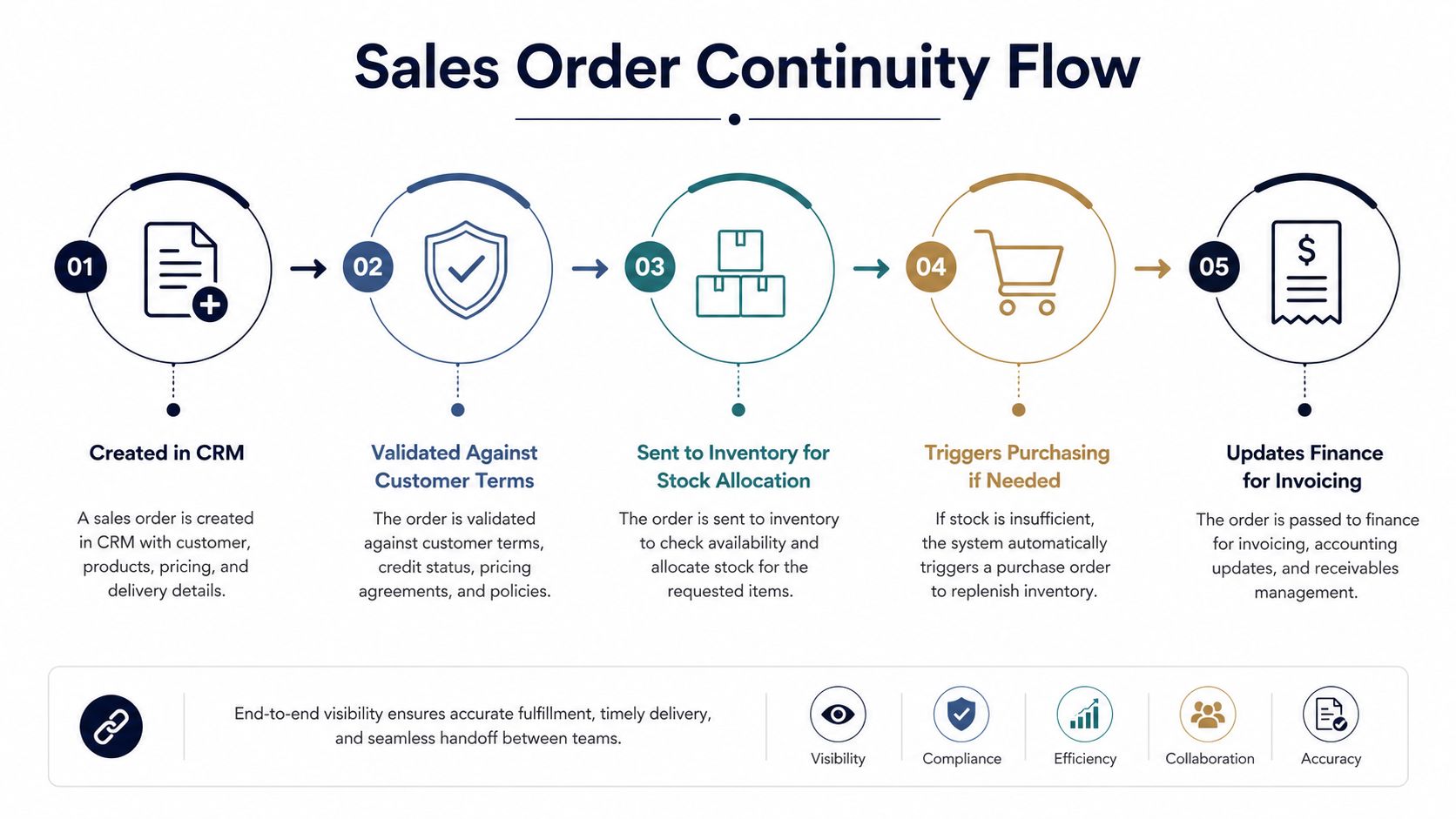
A salesperson creates the order in the sales workspace. The system validates customer terms, pricing, and account status. The order then becomes the shared reference for inventory allocation, purchasing, production scheduling, invoicing, and revenue recognition. Each area receives the same customer, product, order, and price identifiers, so employees aren't rebuilding the transaction from memory.
One order, several authorized actions
If available stock covers the order, inventory records the reservation and sales can use that status when discussing delivery. If stock is low, the change can create a supplier requirement. When the receipt is recorded, available inventory updates against the relevant product and order context rather than sitting in an isolated purchasing record.
Production follows the same chain. A work order can retain quantities, recipes or bills of materials, planned dates, quality information, and status changes. Operations sees whether the order is waiting for material, in production, or ready for dispatch. That continuity is especially valuable for food, cosmetics, pharmaceutical, and light manufacturing businesses where traceability and cost context matter.
Finance sees the originating order alongside deliveries, invoices, and payments. A posted delivery can support invoicing, while payment status returns to the customer account. The owner doesn't need to wait for a separate report to discover that an order was delivered but remains unbilled.
Zynthoro keeps context with the work
Zynthoro connects finance, sales, operations, inventory, and production in one EU-hosted workspace. Its embedded AI can assist with activities such as scheduling, summaries, and workflow support, while the underlying record still shows what occurred and which authorized action followed.
Permissions can restrict who views or changes sensitive fields. EU hosting and governed access support businesses that need clearer control over customer, finance, and personnel data. Independent ERP research also links real-time integration with a single source of truth, workflow automation, observability, faster financial reporting, and immediate visibility into transactions and operations (IBM's ERP integration overview).
The Agency catalog item is listed at €1,199 per month and includes a full non-ERP suite for agencies and multi-client teams, full accounting and inventory, pro project management and marketing, five company workspaces, twenty-five users, and team structures. Its snapshot states No ERP.
Why Synchronization Matters for Small Businesses
Disconnected data becomes expensive because small teams have less spare capacity to repair it. A delayed customer response, an order promised without current stock, or a manual month-end reconciliation takes time directly from selling, delivering, and improving the business.
Real-time synchronization keeps customer records, orders, finance activity, inventory, and production status aligned as employees work. Sales can follow up using current account information. Operations can plan from a more dependable view of demand. Finance can connect delivered goods, invoices, and payments instead of assembling the relationship later.
Cash collection benefits from the same continuity. When invoicing follows delivery and payment status returns to the customer account, the finance team can identify outstanding balances without waiting for a separate report or asking sales to confirm what happened.
The practical gain is not a faster screen. It's fewer moments when two employees act on different versions of the same transaction.
Inventory decisions also become clearer. Reserved, received, manufactured, and shipped quantities can share one operational view, helping teams focus on exceptions rather than proving which spreadsheet is accurate. That distinction matters for an SME because an inventory error can affect customer trust, purchasing decisions, production priorities, and cash flow at the same time.
Zynthoro supports this continuity within a connected business workspace, linking commercial activity, financial control, operational planning, inventory, and production. Consolidating those activities can also reduce the reconciliation work created by separate SaaS tools, although each business should confirm its own process, permissions, migration needs, and reporting requirements before replacing existing applications.
The market direction reflects broader demand for continuous integration. One analysis estimates the global data integration market at USD 15.18 billion in 2024, USD 17.58 billion in 2025, and USD 33.24 billion by 2030, while another places the time-sensitive database software market at roughly USD 8 billion today and projects it to reach nearly USD 20 billion by 2034 (market analysis of real-time synchronization infrastructure). These are market estimates and projections, not a guarantee that every SME needs the same architecture.
Reliability Risks and Common Pitfalls
“Real time” doesn't automatically mean reliable. A system can move updates quickly and still produce wrong results if it mishandles schema changes, duplicate messages, overloaded destinations, or unclear ownership.
Replication latency grows with write volume and geography. In one independent event-driven architecture benchmark, average replication latency at 10,000 events per minute ranged from 142 milliseconds to 173 milliseconds across three regions. At 100,000 events per minute, it ranged from 189 milliseconds to 211 milliseconds, and at 1,000,000 events per minute, it ranged from 247 milliseconds to 275 milliseconds (independent replication-latency benchmark). The pattern shows why regional placement, workload shaping, and realistic freshness targets matter.
The failure modes owners should question
- Schema drift: A product, customer, or account field changes in one application but not another. Reports and downstream workflows may then fail or interpret the data incorrectly.
- Backpressure: A source publishes changes faster than a destination can process them. The queue grows, and “real time” becomes delayed availability.
- Duplicate delivery: At-least-once delivery can resend an order update after a network interruption. Stable event IDs and idempotent processing prevent duplicate totals or stock movements.
- Weak permissions: Broad integration access can expose sensitive customer or finance fields. Role-based permissions should apply across the whole data path.
- Silent failures: An event that disappears into an unread log is still a business failure. Teams need visible alerts, dead-letter handling, and a recovery owner.
Asynchronous replication preserves write availability and low primary-write latency, but replication lag can violate read-after-write consistency, monotonic reads, and consistent-prefix guarantees. Lag is the delay between a primary commit and visibility on a replica, and it can result from network distance, replica I/O saturation, CPU bottlenecks, or large logical change sets (replication lag and consistency guidance).
Design for safe replays and bounded inconsistency. A theoretical promise of exactly-once delivery is less useful than a process that can recover cleanly from duplicates and missed events.
Not every update needs the same delivery path. An order confirmation and inventory reservation deserve tighter controls than a low-priority analytical refresh. Define acceptable freshness by process, validate data before publication, preserve event history, and monitor the full lifecycle from source change to user-visible result.
KPIs and Monitoring for Trusted Data
A synchronization dashboard should answer business questions, not just infrastructure questions. Can sales trust available stock? Can finance see the latest payment status? Can operations explain why a production date changed?
Track six signals:
- Freshness: How old is the latest accepted record in each critical module?
- Failed events: Which events were rejected, quarantined, or sent for manual review?
- Queue health: Are pending events accumulating behind a slow destination?
- Trigger-to-visibility latency: How long does it take for a change to appear where users need it?
- Reconciliation drift: Do source and destination totals, quantities, and statuses still agree?
- User-visible outcomes: Are employees seeing duplicate, missing, or contradictory records?
Use business-owned targets rather than inventing a universal promise of zero delay. The table below gives a practical operating model without assigning unsupported numeric thresholds.
| KPI | What It Measures | Target | Owner | Review Cadence |
|---|---|---|---|---|
| Freshness | Age of the latest valid update | Agreed by workflow | Operations lead | Daily |
| Failed events | Changes needing recovery | No unexplained critical failures | Integration owner | Daily |
| Queue health | Pending work and backpressure | Stable queue with clear escalation | Technical owner | Daily |
| Reconciliation drift | Differences between connected records | Investigated variances | Finance and inventory leads | Weekly |
| Trigger-to-visibility latency | Time from change to usable update | Defined per process | Process owner | Weekly |
| User-visible outcomes | Duplicate or missing records | No recurring defects | Department leads | Weekly |
A short weekly review should bring together finance, sales, operations, and production. Each owner confirms the shared numbers, records exceptions, and assigns a person to investigate anything outside the agreed target.
For broader observability terminology, a real time metrics guide for DevOps can help your technical owner distinguish infrastructure signals from service outcomes. The SME version should remain simple: alert automatically, review regularly, and connect every alert to a business decision.
Choose Continuity Without Adding Complexity
Replacing disconnected tools works best when you start with the business flow, not the software catalogue.
- Map the current path: Follow one order from quote through delivery, invoice, payment, purchasing, and production.
- Define master records: Decide which module owns customers, products, prices, stock, orders, and accounts.
- Set freshness priorities: Give finance, sales, inventory, and production the level of alignment their decisions require.
- Confirm governance: Check EU hosting, role-based access, audit trails, and handling of sensitive information.
- Pilot one process: Start with a visible order-to-cash workflow, test failures and replays, then expand once users trust the shared record.
The aim isn't to assemble more integrations. It's to give the business one connected operating context. Zynthoro combines connected modules, embedded AI assistance, EU-hosted infrastructure, and production capabilities so synchronization can be part of the workspace rather than another collection of fragile interfaces.
Zynthoro connects sales, finance, operations, inventory, and production so each team can work from the same business data as changes occur. Visit Zynthoro to explore a connected, EU-hosted workspace for replacing fragmented tools with dependable real-time continuity.