



A customer calls at 9:10 on a Monday morning. They've found a possible defect in a product shipped from your plant, and they need to know which batch was involved, which supplier supplied the material, what else used the same lot, and where those units went.
You open the shared drive. One person has the receiving spreadsheet. Someone else has the production worksheet. Shipping records live in accounting software, while the quality check is saved as a scanned PDF. The information probably exists, but it isn't connected. That's the operational problem with traceability in manufacturing. A record that can't be found, understood, and linked to the next event isn't much use during a recall.
For small and medium-sized manufacturers replacing disconnected tools, the practical answer is to build one digital thread from incoming material to finished shipment. The system doesn't need to be an enormous IT project. It does need consistent identifiers, disciplined event capture, and a production workflow people can use.
Table of Contents
- The Cost of Lost Records in Manufacturing
- Understanding Batch, Lot, and Serial Tracking
- Why Regulations Are Changing the Rules
- The Problem with Disconnected Tools
- Implementing End-to-End Genealogy
- Managing Recalls with Confidence
The Cost of Lost Records in Manufacturing
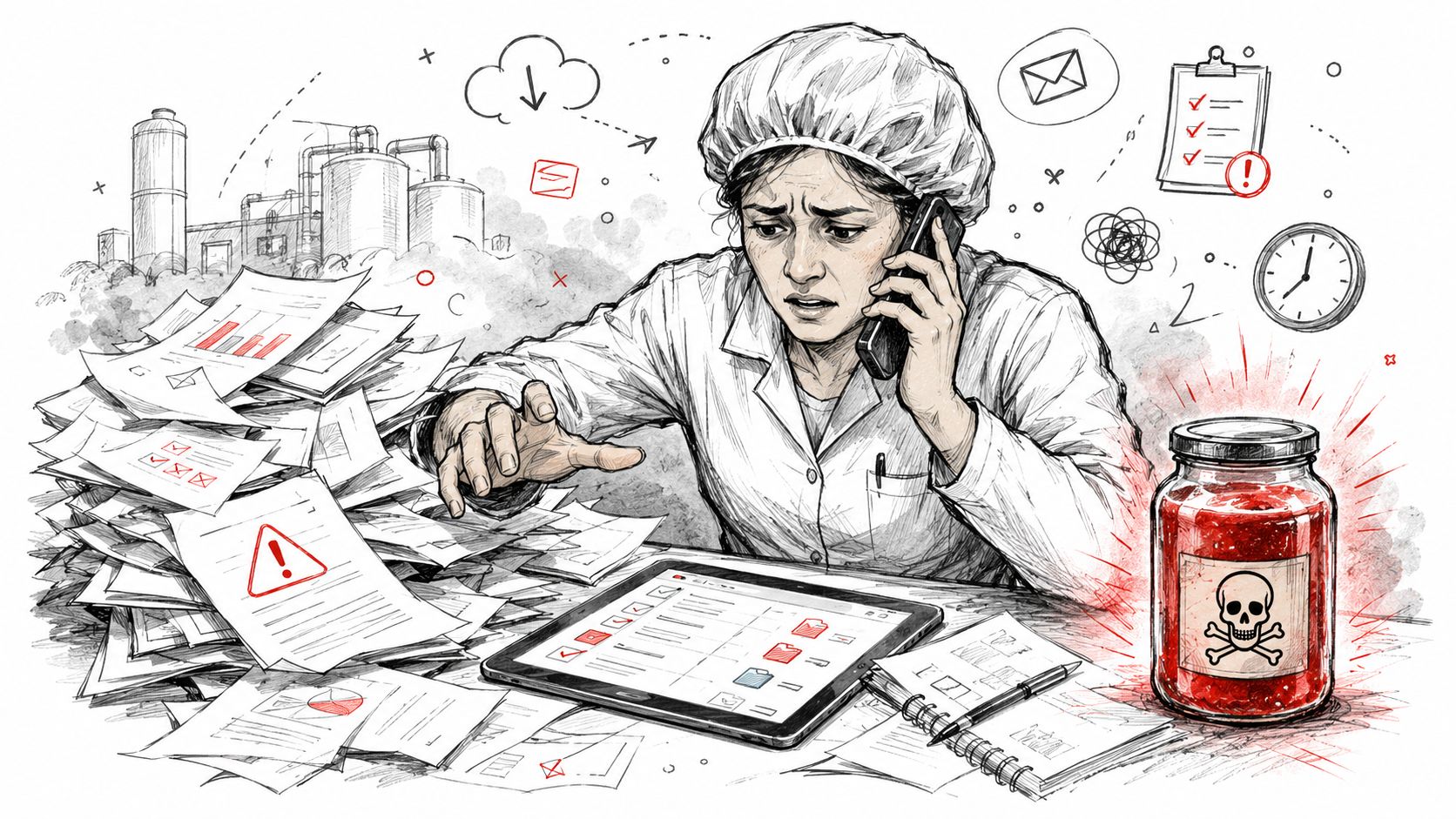
A small food processor receives a complaint about a product made several weeks earlier. It may be an isolated defect, or it may involve a contaminated ingredient. The owner needs immediate answers: which finished goods contain that ingredient, which customers received them, what remains in stock, and whether another run used the same supplier lot.
With paper logs and separate spreadsheets, staff reconstruct the event manually. They search email attachments, compare purchasing records with production notes, and match handwritten lot codes to sales documents. One missing receiving entry or unrecorded transfer can break the chain in both directions.
The delay affects containment, quality investigation, customer communication, and production planning. Traceability is a control for containment, quality investigation, and operational confidence. The OECD reports that consumer product recalls have increased globally in both size and number, with millions of products recalled each year through voluntary or mandatory actions. OECD reporting on product recall effectiveness places the problem in a wider manufacturing context.
Why fragmented records create exposure
OpenText's cited industry analysis reports that 75% of manufacturers experienced at least one product recall in the past five years, and that more than 312 recalls were issued in the first seven months of 2025. The same analysis places typical direct recall expenses at $10 million to $50 million, while some automotive recalls exceed $100 million individually. Those figures do not mean every SME incident will reach that scale. They show how quickly exposure can grow when a business cannot isolate affected product.
A connected record lets a team ask a precise question instead of searching broadly. “Which finished goods consumed supplier lot R-184 during the Tuesday run?” is actionable. “Find everything produced around that time” leaves too much room for delay and error.
Practical rule: If a production event changes inventory, it should also preserve the identity of what was received, consumed, transformed, moved, packed, or shipped.
For SMEs replacing disconnected tools, a single AI-native ERP can connect production, purchasing, inventory, sales, quality control, and lot traceability without turning genealogy into a large IT project. Zynthoro provides that unified operational workspace. Its value lies in linking the material receipt, bill of materials, work order, finished lot, and customer shipment in one working record.
A useful system continues to pay off after the immediate crisis. When managers can see the machine, supplier lot, process step, or inspection result connected to a product's history, quality discussions become specific. Teams can investigate the relationship between material, work, and outcome instead of placing the entire process under suspicion.
Understanding Batch, Lot, and Serial Tracking
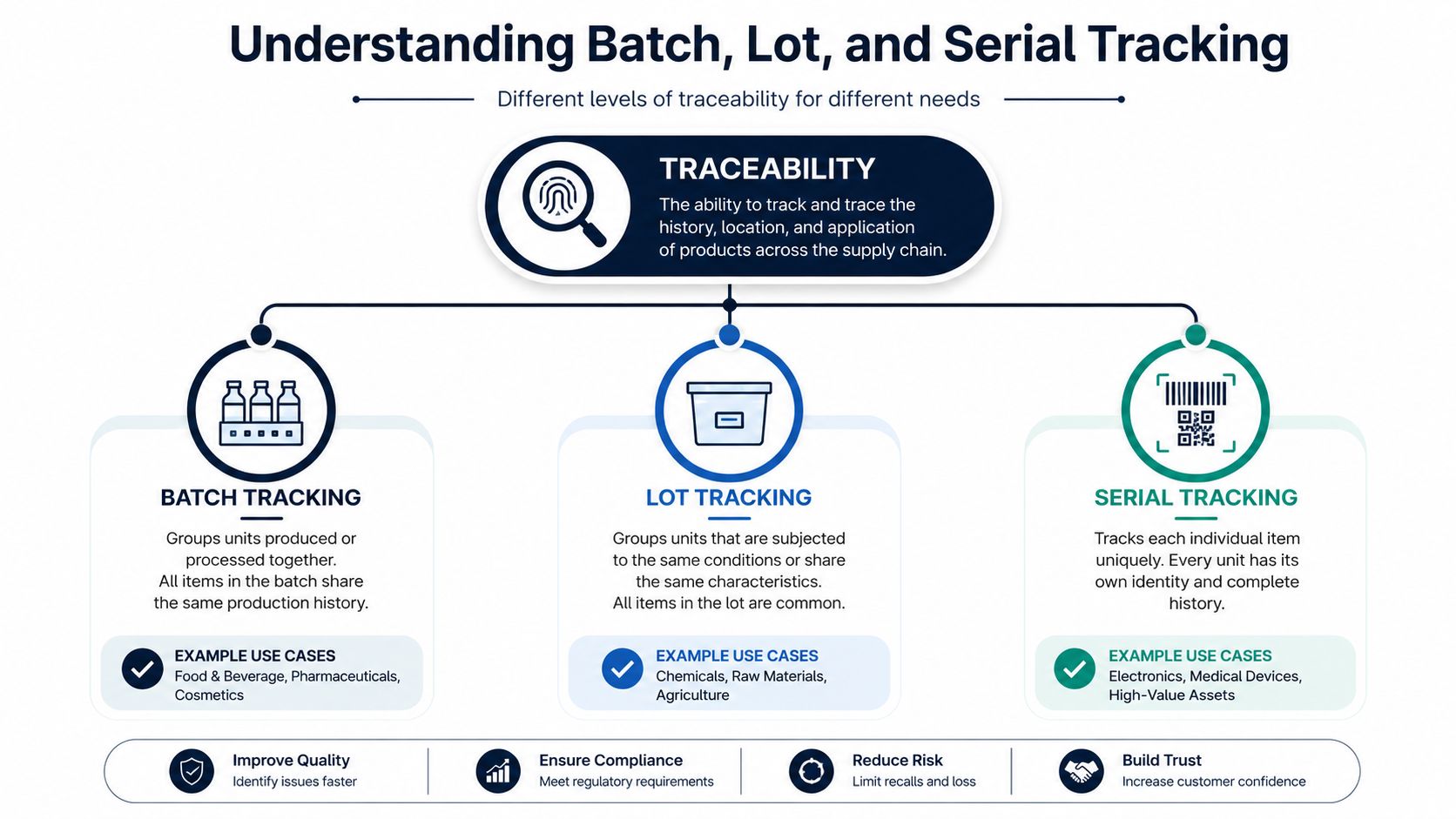
The identifier you choose determines how narrowly you can investigate a problem. Batch, lot, and serial tracking aren't interchangeable, even though teams often use the terms loosely.
Think of a batch as a production group. A bakery might make one batch of sauce during a defined run, using a shared recipe and process. Every unit from that run carries the group's manufacturing history.
A lot is a traceability group connected by a shared material or operating condition. A supplier may deliver an ingredient under one lot code, and your plant may use that lot across several production orders. The lot becomes the bridge between the incoming material and every finished product that consumed it.
A serial number identifies one individual item. It's appropriate when each unit needs its own history, such as a medical device, high-value assembly, or piece of equipment. If one serialized unit fails, the investigation can focus on that item's exact components, inspections, operators, and process events.
Choose the narrowest useful level
Start with the risk and the customer requirement, not the software setting.
- Shared production: Use batch tracking when products are made and released as a group. The record should connect the production run to its ingredients, work order, checks, and shipments.
- Shared material conditions: Use lot tracking when supplier identity, expiration, source, or incoming quality matters. The finished product should retain the consumed material lot.
- Individual history: Use serial tracking when each item must be distinguished from its neighbors. The serial record should follow that unit through production, testing, delivery, service, and any return.
GS1 distinguishes lot-level and serialized item-level traceability in the DSCSA context. Lot-level exchange uses Product ID plus Lot Number, while serialized exchange uses Product ID plus Serial Number. Its DSCSA and traceability implementation guidance also emphasizes having a documented procedure for defining production batch, lot, or serial numbers.
FDA defines a traceability lot code as an alphanumeric descriptor that uniquely identifies a traceability lot in the records of the code source. The practical requirement is simple: the code must remain connected across upstream and downstream records. FDA's traceability lot code definition provides the formal reference.
For a small manufacturer, the sensible setup is often a shared lot record for materials, batch genealogy for production, and serial numbers only where individual identity earns its cost. Zynthoro supports batch, lot, and serial logic in the same operational record. If you're formalizing planning and team workflows before expanding production controls, Kickstarter is listed as a one-time €79 option with lifetime access, AI Assistants with 50 credits per month, Planning & Time Tracking, a Communication module, and Canva Studio.
Why Regulations Are Changing the Rules
Regulation is turning traceability from a quality preference into a defined data discipline. Food manufacturing in the United States shows the shift clearly.
In November 2022, the U.S. FDA published the Final Rule for Requirements for Additional Traceability Records for Certain Foods. It covers manufacturers, processors, packers, and holders handling foods on the Food Traceability List. The rule requires records for defined Critical Tracking Events, including growing, receiving, transforming, creating, and shipping. The FDA's announcement of the final rule explains how these operational events become formal recordkeeping requirements.
The original compliance date was January 20, 2026. The FDA later proposed extending it by 30 months to July 20, 2028. That proposed extension does not change the direction of the requirement. Traceability is becoming more structured, enforceable, and dependent on connected data.
What the rule changes on the floor
A covered manufacturer needs a traceability plan, traceability lot codes, and Key Data Elements linked to the relevant event. A general statement that ingredients are tracked will not answer a regulator's or customer's question.
For a shipment, the business must preserve shipping information for every lot of covered food shipped. For a receipt, it must retain receiving information for every covered lot received. The FDA also requires an electronic sortable spreadsheet of traceability information within 24 hours of a request, unless an exemption applies. The FDA's FSMA Food Traceability Rule guidance sets out these requirements.
That deadline affects system design for an SME. A spreadsheet can be the requested output, but it should not be the primary operating record. If staff have to assemble it manually during an incident, missing links, inconsistent codes, and slow retrieval remain operational risks.
Standards are becoming the shared language
GS1 EPCIS structures event data for commissioning, packing, shipping, receiving, transformation, and verification. It connects identifiers such as GTINs with batch, lot, or serial identifiers in event records, giving suppliers and customers a more consistent way to exchange product and logistics history. The GS1 EPCIS standard matters because trading partners and regulators rarely use the same software.
European requirements add another pressure. Recent reporting describes Digital Product Passports moving toward mandatory, machine-readable lifecycle data. Battery passports are expected to become mandatory in February 2027, with broader requirements developing across textiles, electronics, and construction products. Coverage of EU supply-chain trends and Digital Product Passports describes the continuing development of these manufacturing traceability frameworks.
SMEs can respond by structuring records before a narrow compliance obligation expands. Zynthoro centralizes lot, shipment, receipt, production, and sales information, allowing compliance output to come from normal work instead of a separate emergency exercise.
The Problem with Disconnected Tools
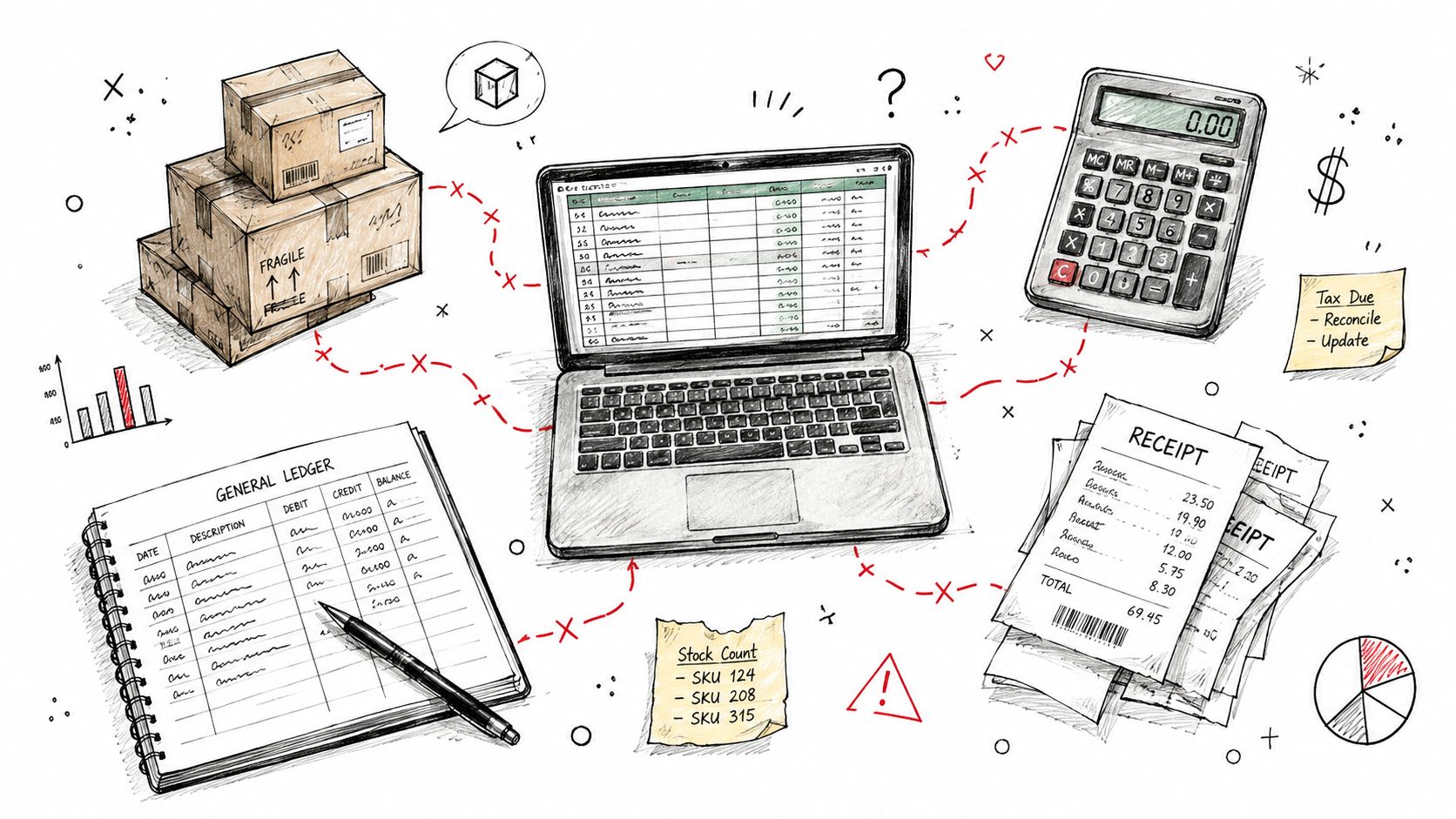
Disconnected tools often look cheaper because each purchase solves one immediate problem. A spreadsheet handles inventory, an accounting package handles invoices, an app manages sales orders, and a paper traveler follows production. The cost appears later, when someone has to reconcile all four systems to answer one traceability question.
The weak point is usually the handoff. Receiving enters a supplier lot into one file. Production copies part of that information into a work order. Finished goods receive a new code, but the relationship to the consumed material is written on paper. Sales records the customer shipment without retaining the full genealogy.
Fragmented versus connected workflows
| Operational question | Disconnected approach | Unified approach |
|---|---|---|
| What arrived? | Search purchase records and receiving files | Open the receipt and its supplier lot record |
| What was consumed? | Compare spreadsheets with work orders | Follow material consumption through the production record |
| What was produced? | Reconcile batch notes with inventory adjustments | Review the finished lot and linked bill of materials |
| Who received it? | Match shipping documents manually | Query linked customer and shipment records |
| What changed? | Collect emails, edits, and paper approvals | Review the system's audit trail and controlled workflow |
Manual tracking doesn't fail because employees don't care. It fails because the process asks people to remember, retype, and transfer identity across tools. Each transfer is an opportunity to omit a lot code, use a different format, or record an event after the fact.
A traceability system should make the correct record the easiest record to create.
What an SME should consolidate first
Start with the events that change inventory or product identity:
- Receiving: Record supplier, material, quantity, lot or serial, date, and inspection status.
- Staging and consumption: Record which material identity moved to the work order and which quantity was consumed.
- Transformation: Link the input records to the output batch or serial record.
- Packaging: Preserve the relationship between finished product identity, packaging materials, and release status.
- Shipping: Link the outgoing lot or serial to the customer, order, and shipment.
Zynthoro is designed as an AI-native ERP for SMEs, with connected production, purchasing, inventory, sales, quality, and finance workflows. The point isn't to eliminate every specialist system immediately. It's to establish one operational source of truth for the records that must remain connected.
A video can help teams visualize the difference between isolated records and a connected production history. Use it as a training prompt, not as a substitute for mapping your own process.
The trade-off is real. Consolidation requires process decisions, data cleanup, and staff training. Keeping the patchwork avoids that transition, but preserves the recurring cost of reconciliation and the risk that a critical link disappears during a transfer.
Implementing End-to-End Genealogy
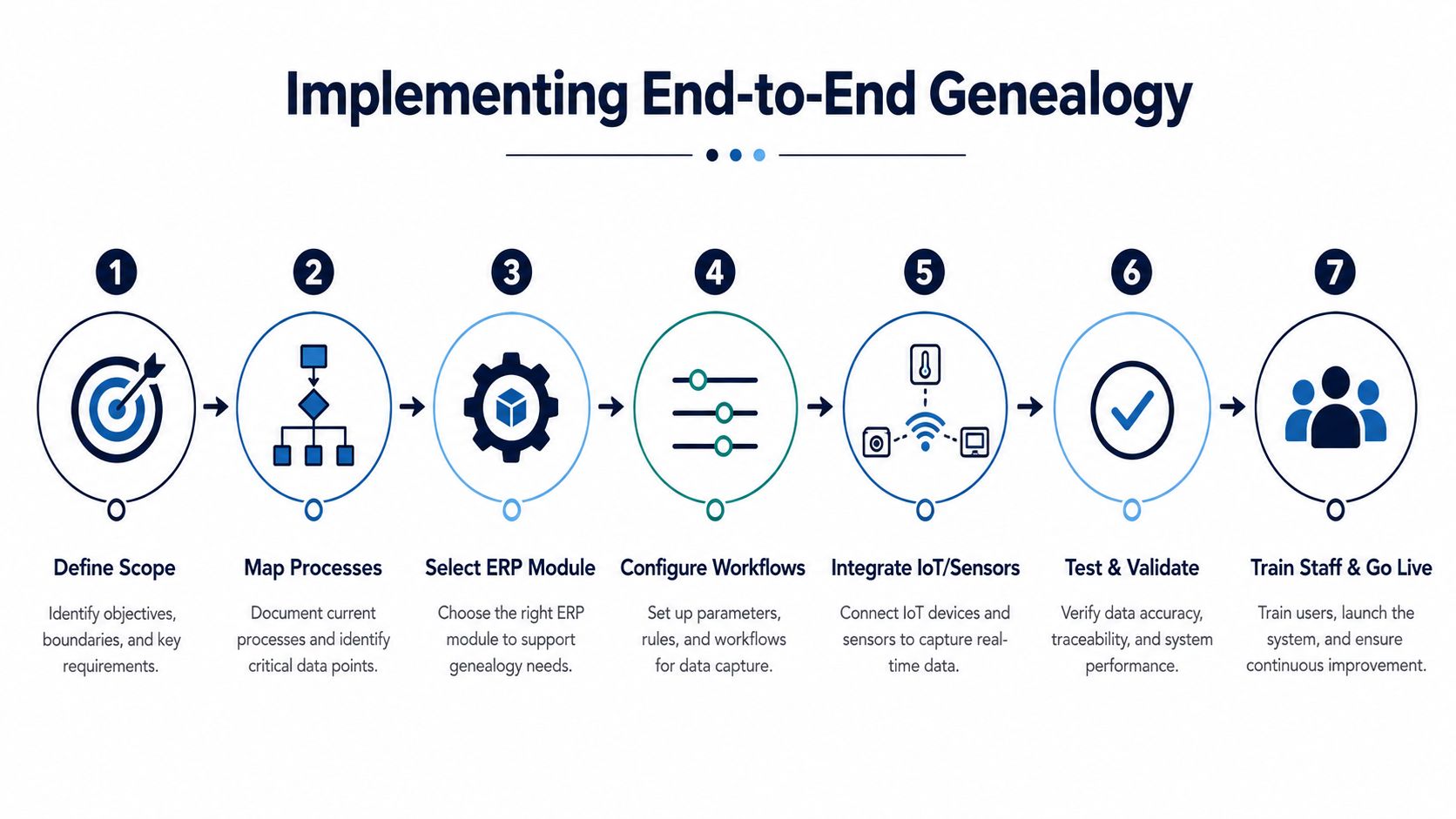
End-to-end genealogy starts with process design, not data import. Before configuring Zynthoro, walk one real product through the plant and list every event where material is received, moved, consumed, transformed, packed, inspected, or shipped.
Build the record around events
Use this sequence for a practical implementation:
Define the scope. Pick a product family, material group, or customer requirement. Don't attempt to digitize every historical record before proving the workflow on current production.
Map the physical process. Document where material enters, where it waits, which work order consumes it, and when the finished product receives its identity.
Set the identifier rules. Decide when the business creates a batch, accepts a supplier lot, assigns a serial, or creates a new output lot. Keep the format consistent and readable on the floor.
Configure the product structure. Link the recipe or multi-level bill of materials to the work order. A finished lot should inherit the identity of the inputs used to make it.
Capture quality at the point of work. Record inspection results, release decisions, nonconformances, and rework against the relevant lot, batch, or serial.
Connect logistics. Tie packing and shipping records to the finished identity and customer order. A product isn't fully traceable if production knows its history but shipping can't identify its destination.
Test the workflow. Run a backward trace from a finished shipment to raw materials, then run a forward trace from one supplier lot to every affected finished product and customer.
The end-to-end genealogy benchmark guidance identifies receiving, staging, consumption, transformation, packaging, and shipping as inventory-changing events that need connected genealogy. It also describes 90% to 95% node completeness as a practical benchmark in food and beverage plants, while medical device and aerospace contexts target 99.9%. These are useful reference points, not excuses to accept gaps. Your target should reflect product risk, contract requirements, and the consequence of a missing component.
Run a controlled mock recall
Choose a finished lot that has already shipped. Search the finished record, identify the consumed input lots, list the other products that used those inputs, and produce the affected customer and shipment list. Then reverse the exercise by selecting a supplier lot and checking every downstream product and destination.
Track the orphan-event rate, customer-impact query time, and mock-recall duration. Those measures reveal whether your system preserves identity through production or merely creates a report at the end.
Zynthoro's production management features include recipes, multi-level BOMs, work orders, quality control, lot traceability, and cost roll-ups. For a small plant, that combination helps keep genealogy inside the same workflow as the work itself, instead of creating a separate compliance project.
Managing Recalls with Confidence
A recall exposes the difference between stored data and usable traceability. The practical test is simple: can the right person identify affected product, explain the connection, and support the decision without rebuilding the history from separate files?
Start with containment. Place the suspect lot on hold, block further allocation, and record why the hold was issued. Trace backward through the material, supplier, process conditions, inspection results, and production order. Then trace forward to finished goods, inventory locations, customers, and shipments.
Use the recall as a business test
A mock recall should answer specific operational questions:
- Which input lot or process event started the investigation?
- Which finished batches or serialized items contain that input?
- Which units remain in stock or work in progress?
- Which customer orders and shipments are affected?
- Which records support the release, hold, or recall decision?
- Can the team export the requested information in a usable format?
For food businesses covered by the FDA rule, the requested electronic sortable spreadsheet must be supplied within 24 hours, unless an exemption applies. FDA's FAQ on the Food Traceability Rule states that the rule covers foods on the Food Traceability List, applies to relevant manufacturers, processors, packers, and holders, and requires records to be kept for 24 months.
Measure response, not software ownership
Track customer-impact query time, mock-recall duration, and the orphan-event rate. These measures show whether identity survives each handoff or whether the system only produces a report after someone has manually reconciled the records.
Independent industry guidance notes that well-designed operations can complete a full backward and forward trace in under 4 hours, while some automated systems report mock-recall completion in under 30 minutes. Those figures are reference points, not promises. Your own test must show whether receiving, production, quality, inventory, and shipping can reach the same answer from one connected record.
The implementation gap remains substantial. Independent 2026 coverage says many manufacturers lose data during manual tracking or transfers between systems, and one industry source reports that fewer than 20% can trace a product from raw material to end consumer with verified data. Coverage of traceability in production highlights the practical issue for SMEs: creating a reliable digital thread while paper, spreadsheets, and disconnected workflows remain in use.
Replace the highest-risk handoffs first. Give receiving one place to record supplier lots, production one place to consume and transform them, and shipping one place to preserve the destination. Run a mock recall before a customer complaint makes the test urgent.
A connected system also supports audit readiness and cost control. It will not prevent every defect or replace disciplined operators and sound quality decisions. It gives those people the evidence to contain a problem without treating the entire business as suspect.
Zynthoro connects production, purchasing, inventory, sales, quality control, finance, and audit-ready records in one AI-native ERP workspace for SMEs. Visit Zynthoro to see how a unified workflow can preserve lot and batch genealogy from receiving through shipment, then test one real product with one mock recall.