



You're closing the month with invoices in an email inbox, purchase orders in spreadsheets, delivery notes on a colleague's desk, and bank payments that don't clearly identify which bills they settle. The finance team can reconcile everything eventually, but only after chasing suppliers, checking duplicate entries, and rebuilding the payment trail by hand.
That routine turns a basic control into a recurring cash-flow risk. Invoice reconciliation software brings the documents, matching rules, approvals, and ledger entries into one process. For European SMEs, Zynthoro provides a connected workspace for purchasing, invoicing, accounting, operations, and compliance, so reconciliation can happen continuously instead of becoming a month-end rescue exercise.
Table of Contents
- Why Invoice Reconciliation Still Slows Down Small Teams
- How Automated Reconciliation Works From Capture to Close
- Matching Rules That Decide What Auto Clears and What Gets Held
- Handling Exceptions and Messy Payments Without Losing Control
- Connecting Your Accounting Invoicing and Bank Data in Zynthoro
- Measuring Success and Keeping Reconciliation Healthy
Why Invoice Reconciliation Still Slows Down Small Teams
A small wholesaler might receive an invoice for ten items, a purchase order for ten items, and a goods receipt showing that only nine arrived. The bank feed then shows a lump-sum payment covering several supplier bills. Someone has to determine whether the invoice should be paid in full, held, partially credited, or grouped with another settlement.
That person may also be responsible for payroll, VAT preparation, customer collections, or stock control. Manual reconciliation doesn't just consume time. It forces important decisions to live in inboxes, spreadsheets, and personal knowledge, where another team member can't easily review them.
The market is moving because finance teams have reached the limits of disconnected tools. Independent research estimates the global accounts payable automation market at about US$6.17 billion in 2025, with a projection of roughly US$12.46 billion by 2031, representing a 12.44% CAGR from 2026 to 2031. A separate estimate places invoice processing software at US$23.6 billion in 2024, rising to US$43.2 billion by 2030 at a 10.6% CAGR. These figures are reported in Mordor Intelligence's AP automation market analysis.
The cost of waiting until month-end
Manual review also delays the moment when owners can trust their cash position. An invoice may be approved but not posted, paid but not matched, or recorded against the wrong supplier. By the time the discrepancy appears, the original context may be difficult to recover.
The better model is continuous control. Each invoice enters a shared workflow, gets checked against the available evidence, and either clears or moves to a named exception queue. Zynthoro is designed for that connected approach, with finance, purchasing, and operational data available in one environment rather than separated across tools.
Practical rule: If reconciliation depends on one person remembering why a payment was assigned, the process isn't controlled well enough.
A move away from spreadsheets is also a systems decision, not merely a software purchase. Founders planning that transition may find this guidance on system migration for founders useful, particularly when deciding which records, workflows, and controls need to move together.
How Automated Reconciliation Works From Capture to Close
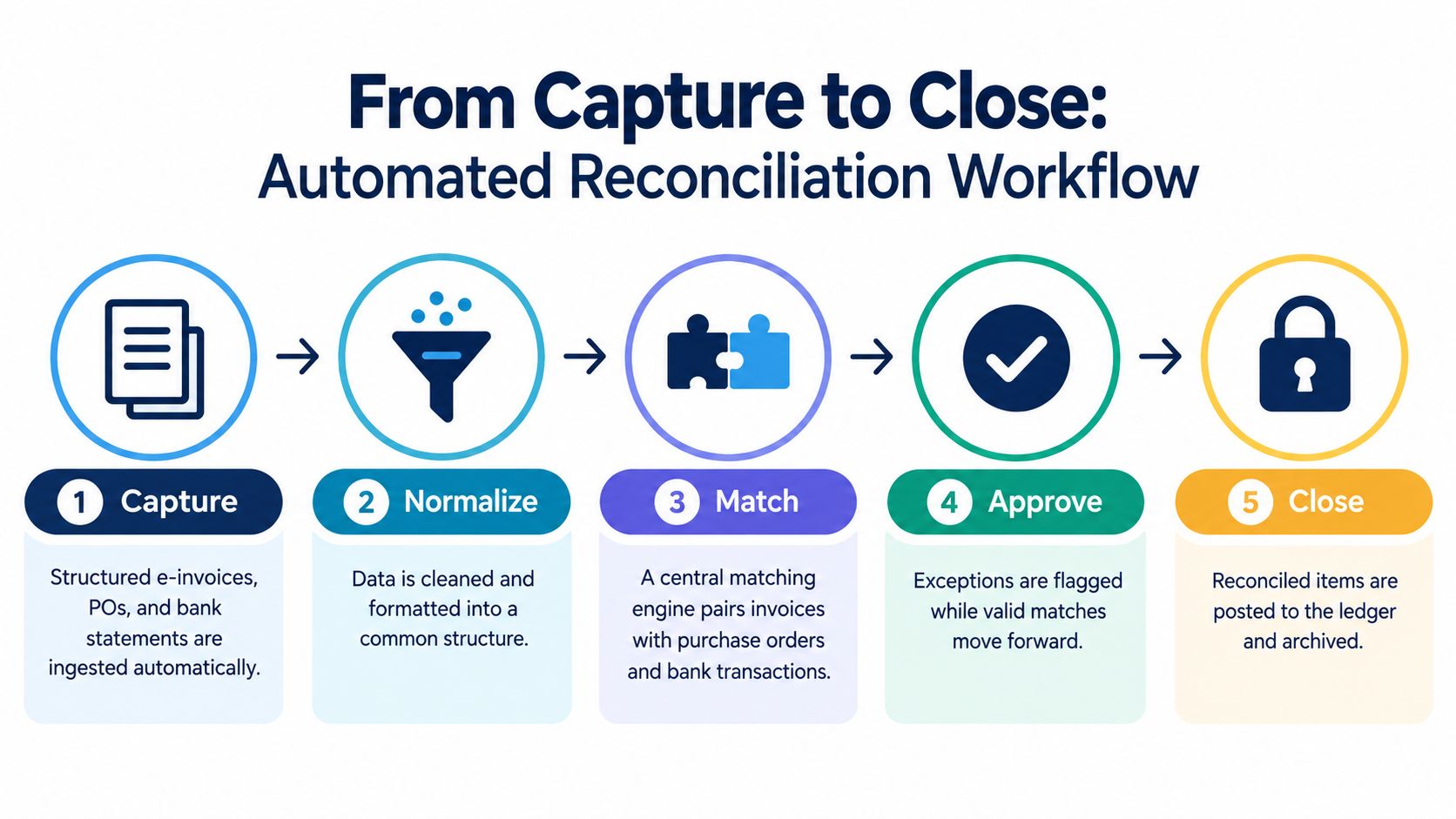
Automation works when the handoffs are connected. The system needs access to the documents that explain a transaction, not just the invoice itself. For a typical goods purchase, that means the structured e-invoice, approved purchase order, goods receipt, and relevant bank transaction.
Capture and normalize
First, Zynthoro ingests the available records into its EU-hosted finance environment. Structured invoice data is preferable because fields arrive in a predictable format, but the workflow still needs to validate the information before it can be trusted.
Normalization makes supplier names, currencies, tax fields, item descriptions, and units consistent. Without that step, the same supplier or product can appear under slightly different labels in different systems, preventing reliable matching.
Validate and match
The platform checks header data such as supplier identity, invoice number, date, currency, tax treatment, and total value. It then compares invoice lines with the purchase order and goods receipt, using configured tolerance bands for acceptable price and quantity differences.
For example, a purchase order might contain ten units of packaging material. The receipt records the quantity delivered, and the supplier invoice records what it wants paid. A clean match can move forward. A quantity difference or unexpected charge should be routed for review instead of posting.
Approve and close
Valid matches proceed through the relevant approval path. Exceptions go to the person who can resolve them, such as the buyer for a purchase variance or the warehouse lead for a receipt discrepancy. Once approved, the reconciled transaction is posted to the ledger and retained with its supporting records.
That audit continuity matters more than a polished dashboard. Owners need to see what arrived, who approved it, what changed, and when the payment was matched. Teams looking for a broader view of connecting payments to accounting may also benefit from this resource on gaining financial clarity with Suby.
Human review still has a role. The aim isn't to force every transaction through automatically. It's to reserve judgment for ambiguous or financially important cases while routine, well-supported matches close without manual keying.
Matching Rules That Decide What Auto Clears and What Gets Held
Matching rules determine whether automation creates control or moves errors faster. A service invoice may only need a two-way comparison against an approved purchase order or contract. Goods procurement normally needs a three-way match between the purchase order, delivery note or goods receipt, and supplier invoice.
A three-way match should compare records at both header and line-item level. Relevant checks include quantity, unit price, total value, tax treatment, item description, and purchase-order approval status. Zynthoro can use these relationships to validate what the business ordered, what it received, and what the supplier billed before payment release.
Choosing the right level of strictness
Strict rules suit high-risk purchases, controlled inventory, and suppliers with a history of billing errors. Tolerant rules can work for recurring suppliers where small price or quantity differences are expected and properly authorized.
| Rule Type | What It Checks | Best For |
|---|---|---|
| Two-way match | Invoice against purchase order, contract, price, and supplier details | Consulting, subscriptions, and other service purchases |
| Three-way match | Invoice, purchase order, and goods receipt at line level | Inventory, manufacturing, wholesale, and physical goods |
| Tolerance-based match | Permitted price and quantity variance before an exception is raised | Recurring suppliers with approved commercial allowances |
| Strict hold | Any missing reference, unapproved order, or material variance | Higher-risk goods, regulated purchases, and unfamiliar suppliers |
The tolerance should be visible and governed. If the system clears an invoice because a variance falls inside the permitted band, that decision should remain traceable. If the variance exceeds the rule, the workflow should explain why the invoice was held and identify the next owner.
Master data makes matching possible
Many teams blame the matching engine when the problem is incomplete upstream data. A supplier may omit the PO number, the warehouse may delay posting a receipt, or the item catalogue may use different units from the supplier invoice. No matching logic can reliably resolve evidence that never entered the system.
A practical setup starts with approved suppliers, consistent item codes, clear purchasing responsibilities, and timely receipt posting. Zynthoro's Purchase Administration and Operations workflows help keep those records connected to accounting and invoicing, which gives the matching engine better material to work with.
The benchmark gap shows why the configuration matters. Best-in-class AP teams report an invoice exception rate of about 9%, compared with roughly 22% on average, according to the Zycus discussion of three-way match exceptions. Even strong automation needs a controlled human-exception process.
Handling Exceptions and Messy Payments Without Losing Control
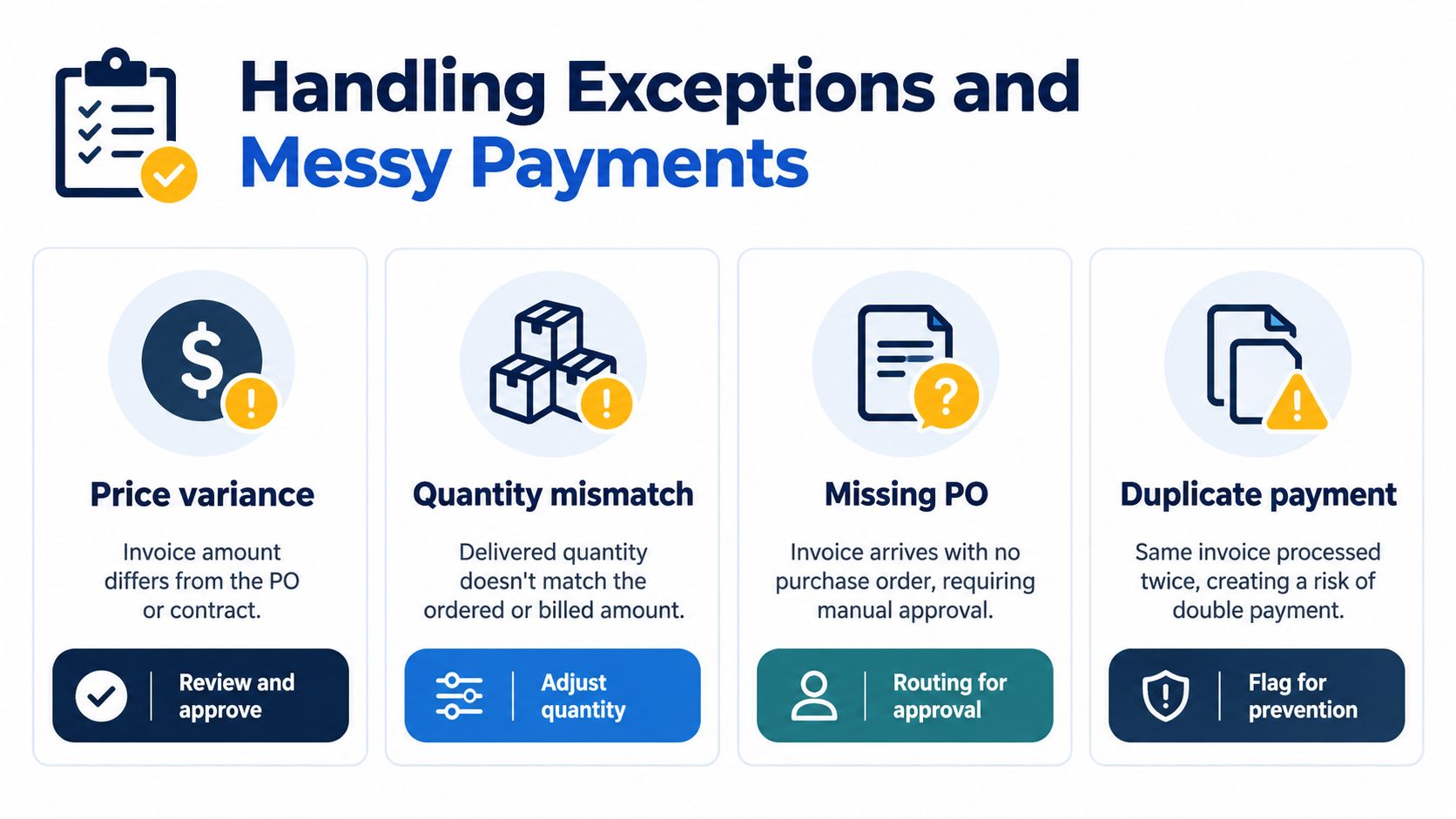
A held invoice isn't a failure. An unexplained held invoice is. The team needs a consistent way to classify the issue, assign ownership, request evidence, and record the resolution.
The common procurement exceptions are familiar:
- Price variance: Compare the invoice with the approved PO, contract, or supplier update, then route it to the buyer for approval or correction.
- Quantity mismatch: Compare ordered, received, and billed quantities. Ask the warehouse to confirm the receipt or request a supplier adjustment.
- Missing PO reference: Search related orders and contracts before sending the invoice through a defined non-PO approval route.
- Duplicate invoice: Check supplier, invoice number, amount, date, and previous payment status before allowing another posting.
Cash application needs a different playbook
Simple invoice-to-PO matching breaks when the bank transaction doesn't carry a clean invoice reference. A customer or supplier may settle several invoices in one batch payment, pay only part of an invoice, apply a credit, or send a lump sum that covers invoices across entities or currencies.
Treat these as cash-application cases rather than forcing them into a purchase-matching rule. Zynthoro should retain the bank description, settlement amount, linked invoices, credits, exchange-rate difference, and user decision in one audit trail. The reviewer can then split or allocate the payment while preserving the relationship between the bank entry and the underlying documents.
Cross-currency settlements deserve particular care. A payment can be correctly allocated even when its translated value differs from the invoice value because of foreign-exchange movement. The system should distinguish an authorized FX difference from an unexplained short payment, not treat both as the same exception.
Better matching logic helps, but complete upstream data and disciplined payment references determine whether automation works in practice.
Supplier correction is part of the control loop. When an invoice contains the wrong quantity or price, record the request, hold the affected item, and close the case only when the corrected invoice or approved adjustment arrives. For agencies and multi-client teams managing several workspaces, Agency is listed as a full non-ERP suite with accounting, inventory, project management, marketing, five company workspaces, and twenty-five users.
Connecting Your Accounting Invoicing and Bank Data in Zynthoro
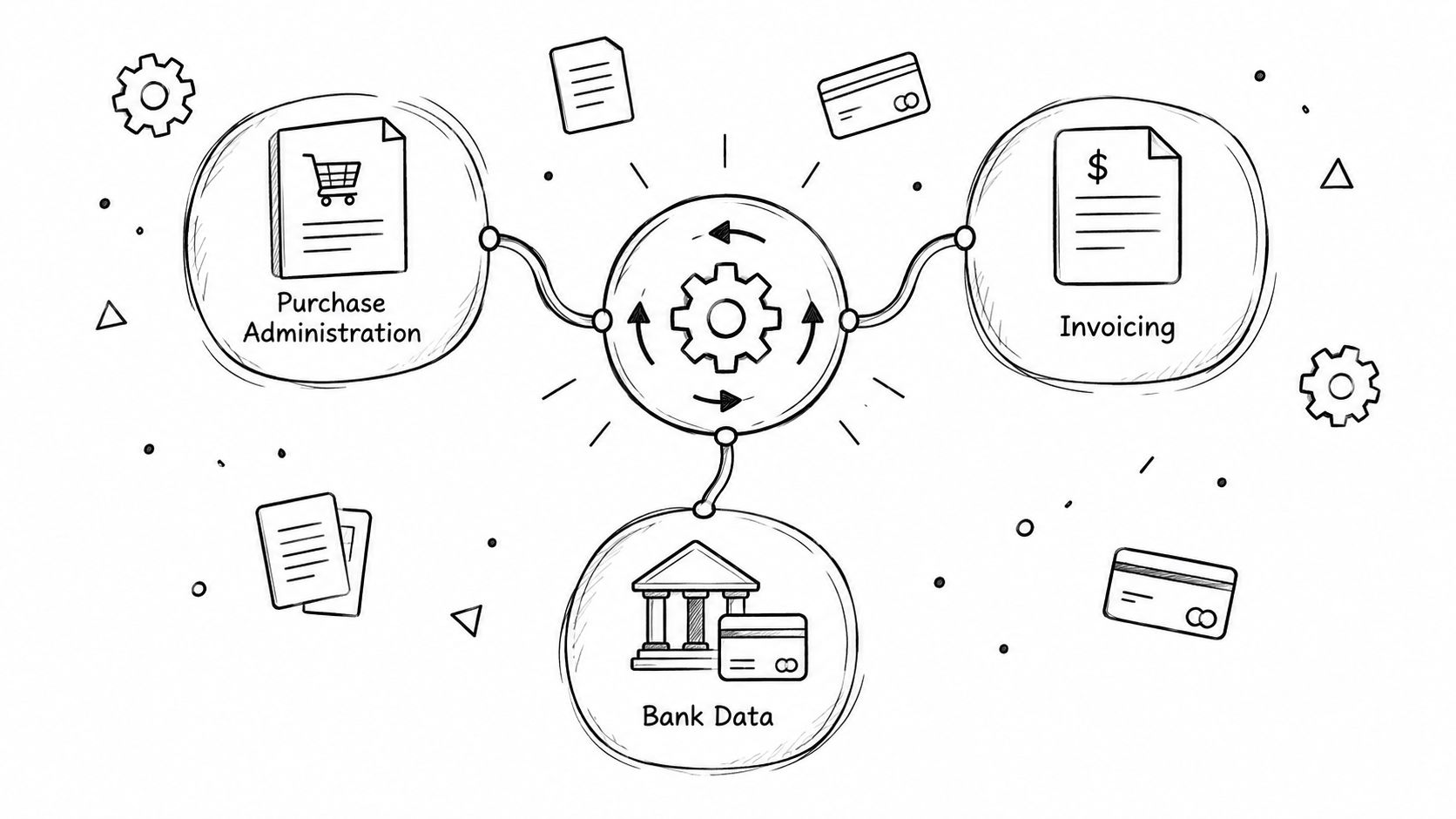
Reconciliation holds up better when finance stops moving fragments between applications. Zynthoro connects Purchase Administration, Invoicing & Finance, Accounting, and Operations through a shared data model. The purchase order, receipt, supplier invoice, approval, and bank transaction can stay in one chain rather than being re-entered across separate tools.
EU data requirements belong in the workflow
European SMEs need an invoice process that handles structure and jurisdiction, not only an inbox. In France, e-invoices use structured formats such as UBL or CII, include fields such as supplier and customer SIREN numbers, and pass through approved platforms. Additional invoice data is scheduled to become mandatory for SMEs from 1 September 2027, according to the French tax authority's electronic invoicing guidance.
The control should run before posting. Reconciliation software can check the file structure, tax treatment, and jurisdictional fields before an invoice enters the ledger. Zynthoro's EU-hosted environment, VAT-aware accounting, GDPR-ready controls, role-based access, and audit trails support that wider process.
A practical integration checklist
Before retiring disconnected tools, confirm that:
- Purchasing records connect: Approved POs, suppliers, items, and receipt status are available to finance.
- Invoices remain structured: Required fields, tax treatment, and supplier identity survive capture.
- Bank data arrives consistently: Payment references and settlement details can be allocated without rebuilding the payment history in a spreadsheet.
- Approvals are explicit: Each exception has an owner, deadline, and recorded decision.
- Access is controlled: Staff can review the records required for their role without unrestricted financial access.
- Field data has a route: Voice-assisted capture can help production and field teams submit information while work is happening.
This setup suits SMEs that have accumulated separate tools for purchasing, invoicing, stock, banking, and collaboration. The objective is practical: keep the evidence connected so finance can explain each posting, resolve exceptions, and support compliance without reconstructing the transaction later.
Measuring Success and Keeping Reconciliation Healthy
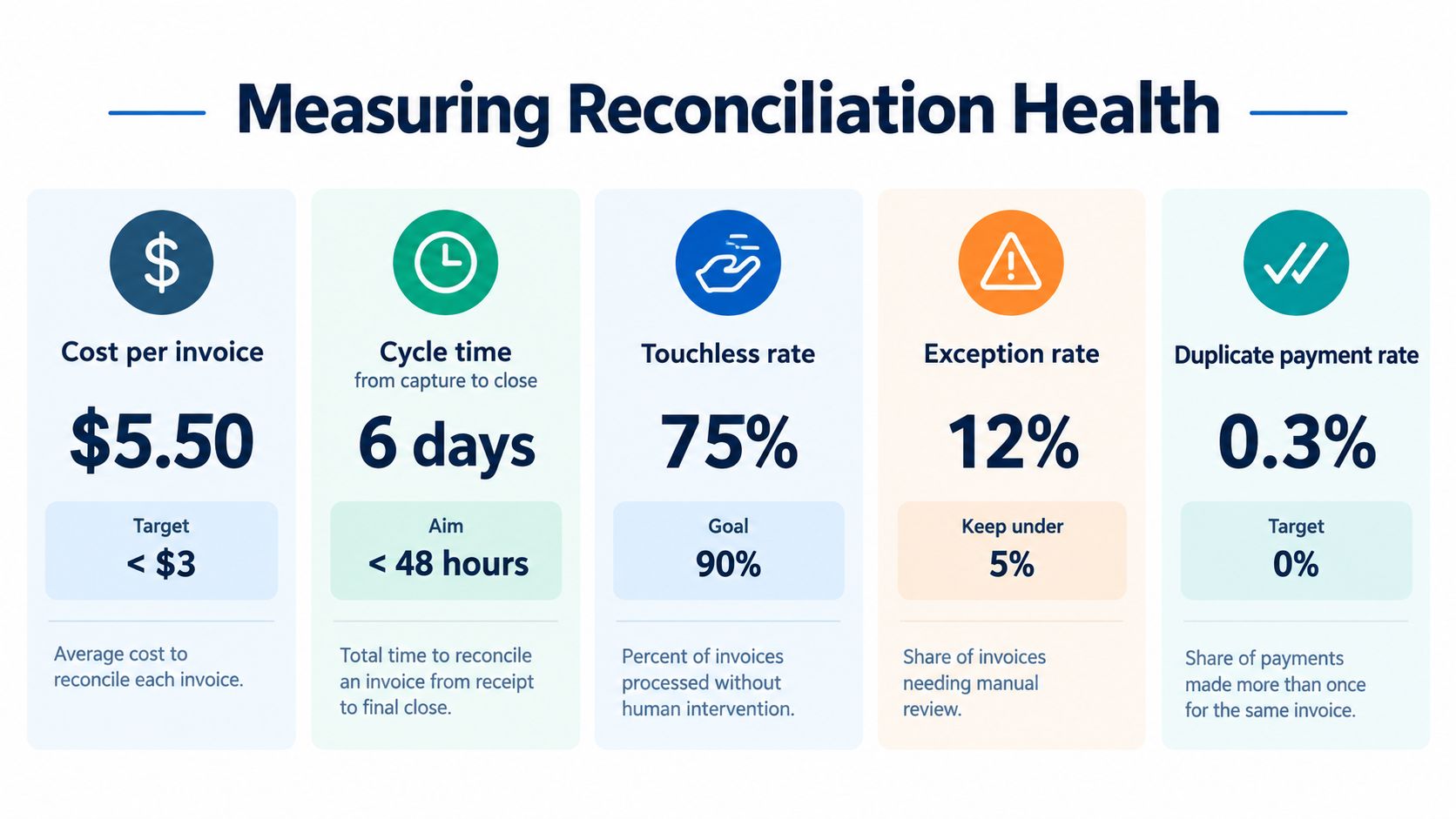
Automation needs operating metrics, not just a launch date. Track cost per invoice, invoice-to-payment cycle time, touchless processing, exception rate, and duplicate-payment exposure. These measures reveal whether the system is reducing manual work or merely creating a faster queue of unresolved items.
Current benchmarks provide useful reference points. Best-in-class teams report cost per invoice around US$2.07 to US$2.78, compared with a median of roughly US$5.83 and poor performers above US$10, while invoice-to-payment time is about 2.8 days for top performers, around 5 days at the median, and 17.4 days for bottom-quartile teams. These figures come from Cadel's AP automation benchmarks.
The same benchmark summary reports 60% to 80% touchless processing for best-in-class teams versus about 35% at the median. A separate 2025 summary based on Ardent Partners reporting says 73% of AP departments use some form of invoice-processing automation, up from 56% in 2022 and 64% in 2023. Those adoption figures are cited in the Gennai invoice automation report summary.
Review the exceptions, not only the averages
Zynthoro users should review exception queues weekly and look for recurring causes. If the same supplier repeatedly omits a PO reference, fix the supplier process. If receipts arrive late, assign responsibility to the operational team. If duplicate warnings cluster around credit notes, adjust the matching rule and approval path.
The control is healthy when routine invoices clear predictably, exceptions reach the right person, and the ledger reflects decisions with supporting evidence. It isn't healthy when the touchless rate looks attractive but unresolved items accumulate outside the system.
Start with one supplier group or purchase category, measure the baseline, and tighten the rules as the team learns. Zynthoro offers connected purchasing, invoicing, accounting, bank reconciliation, VAT-aware reporting, audit trails, and AI-assisted workflows in an EU-hosted ERP workspace. Visit Zynthoro to see how it can replace spreadsheet matching with continuous control over cash flow and compliance.