



You open the day by checking a project tracker, then a spreadsheet, then email, chat, invoices, timesheets, and a calendar. A client asks for an update while a team member waits for a decision, and you spend the next hour reconstructing the truth from disconnected tabs. The work may be moving forward, but the information needed to manage it is scattered everywhere.
That's the practical problem behind project management in AI. For small and medium-sized businesses, AI isn't useful merely because it can write a summary or answer a question. It becomes valuable when it can work with the same project, time, finance, customer, and operations data your team already depends on. Zynthoro approaches that problem as an AI-native ERP platform, rather than another isolated productivity add-on.
Table of Contents
- Why Project Management in AI Matters for Small Businesses
- How AI Transforms Project Management Workflows
- Measurable Benefits of AI-Driven Project Management
- Real-World Use Cases and Embedded AI Assistants
- Risks and Adoption Barriers You Should Know
- How to Adopt AI Project Management in Your SME
- Building Your AI-Native Project Management Future
Why Project Management in AI Matters for Small Businesses
A small agency can have one person updating a project board, another tracking hours in a spreadsheet, and someone else preparing an invoice from a separate system. The owner then checks chat messages to discover whether a deliverable is blocked and opens the calendar to work out who has capacity. Nothing is necessarily broken, but every handoff creates an opportunity for delay, duplication, or error.
The hidden cost isn't limited to software subscriptions. Fragmented tools force people to copy information, reconcile conflicting versions, and ask questions that a connected system should answer immediately. A project manager may know that a deadline is at risk, but finance may not know which work has been completed, and the sales team may not see the delivery impact of a change request.

Fragmentation creates management blind spots
Disconnected tools separate events that belong together. A task completion should inform time tracking, project progress, billing, and client communication. When those records live in different places, the business relies on manual discipline to reconnect them.
That discipline becomes fragile during busy periods. A missed status update can hide a bottleneck. An outdated capacity sheet can lead to an unrealistic assignment. A sales promise can reach delivery without the operational context needed to fulfill it.
Practical rule: If your team has to re-enter the same project information in multiple systems, the business is paying for that duplication every day.
AI-native means connected by design
An AI assistant bolted onto a legacy project board can generate text, but it may not know whether the underlying hours were logged, whether an invoice was sent, or whether production has enough material to complete the work. The assistant is only as reliable as the narrow slice of data it can access.
An AI-native platform starts with connected records. AI can summarize activity, highlight exceptions, suggest priorities, and support decisions because the project data sits alongside the operational information that gives it meaning. That distinction matters for SMEs. You don't need another clever window. You need fewer places to check before making a decision.
How AI Transforms Project Management Workflows
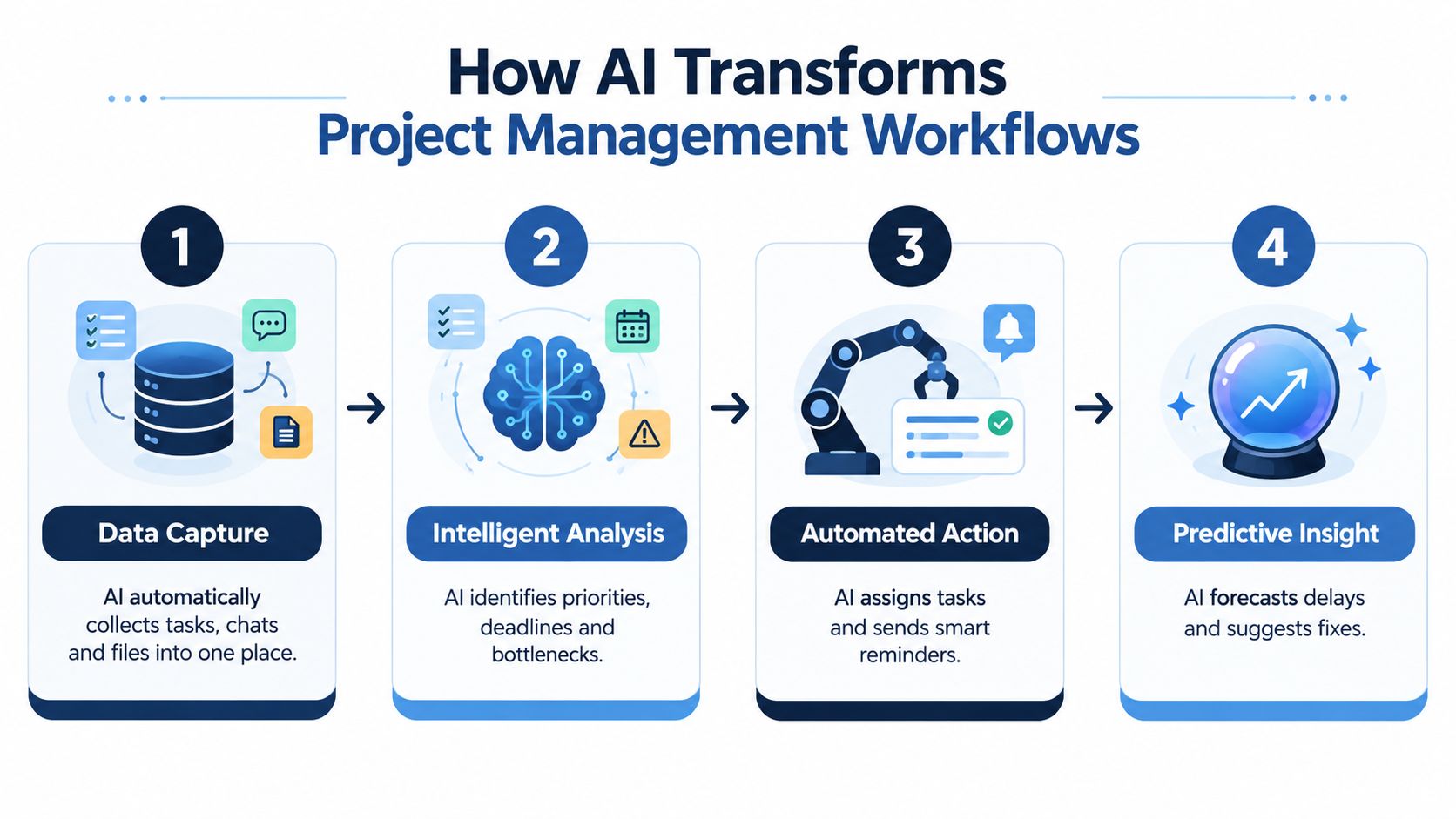
AI works best in project management when it follows the workflow from evidence to action. Think of it as an operations layer that watches the flow of tasks, conversations, files, time, and financial records, then helps the team decide what deserves attention.
The first step is data capture. Tasks, messages, documents, deadlines, and updates need to enter a shared workspace. If a project manager keeps the plan in one application while delivery notes remain in chat, the AI sees an incomplete picture. Connected records matter more than an impressive prompt box.
From routine automation to decision support
Once information is captured, AI can classify tasks, identify priorities, summarize discussions, and prepare status updates. Those are useful but relatively straightforward applications. They reduce administrative work without changing who owns the decision.
The next layer is analysis. AI can compare current progress with project history, inspect dependencies, detect unusual task durations, and identify patterns associated with bottlenecks. It can also help allocate work by considering capacity, skills, deadlines, and existing commitments rather than relying on a manually maintained availability list.
Schedule risk analysis deserves careful handling. The FTI Consulting guidance on AI and schedule risk describes AI as a pre-analysis layer, where historical schedules help surface unrealistic durations, weak logic links, and optimistic baselines before deterministic risk modelling. That sequence is important. AI improves the schedule inputs first, while the project team and formal modelling process remain responsible for evaluating the forecast.
Embedded intelligence beats a chatbot on the side
A standalone chatbot may tell you how to write a project update. An embedded assistant can potentially prepare that update from the task status, time entries, discussions, and financial context already attached to the project. The second approach reduces the gap between what the AI says and what the business is doing.
This is also why integration choices matter. Teams using Jira or similar systems can explore the practical relationship between project records and AI workflows through Averta's MCP Jira page. The useful question isn't whether AI can generate another response. It's whether the response is grounded in current records and can lead to an accountable action.
Measurable Benefits of AI-Driven Project Management
The business case for AI-driven project management appears when disconnected tools stop forcing managers to reconstruct reality. A task board, finance system, timesheet, and message thread may each contain useful information, yet the hidden cost lies in reconciling them before anyone can act. An AI assistant embedded in one ERP platform can connect those signals and support decisions from a shared operational record.
A study in the International Journal of AI-Driven Software Engineering found a 42% increase in project success rates, a 58% reduction in decision-making time, and a 36% improvement in resource optimization compared with traditional approaches, as reported in the study on AI-driven agile governance. The study also reported correlations between AI adoption and on-time delivery, budget performance, and quality, with values of r=0.78, r=0.72, and r=0.81 respectively. Those findings describe an agile governance context, not a guaranteed outcome for every SME. They still show the value of connecting project data, analysis, and action.
What the numbers mean operationally
For a small team, shorter decision cycles can resolve an assignment conflict before it affects a client commitment. Resource optimization can reveal that a specialist is overloaded while another qualified person has capacity. Stronger governance can expose a weak plan before the business commits more money, staff time, and reputation.
The comparison below separates the operating models. Traditional methods can work, but they rely heavily on manual review and timely updates. AI-augmented methods add ongoing analysis and recommendations, while managers remain responsible for validating consequential decisions.
| Metric | Traditional Approach | AI-Augmented Approach |
|---|---|---|
| Decision speed | Periodic reviews and manual information gathering | Faster evaluation of connected project signals |
| Budget performance | Finance and delivery records reconciled separately | Project activity assessed alongside financial context |
| Resource optimization | Manual assignment based on reported availability | Recommendations informed by capacity, workload, and project demands |
| Schedule confidence | Baselines reviewed after problems appear | Historical pattern matching flags weak assumptions earlier |
| Reporting | Manually assembled status updates | AI-generated summaries based on current records |
| Delivery reliability | Reactive intervention after slippage becomes visible | Automated monitoring supports earlier investigation |
Measure the right outcomes
Do not make the number of AI-generated summaries the goal. Track whether managers spend less time assembling reports, blocked work becomes visible sooner, and invoices reflect completed delivery more consistently. These measures expose whether the platform is reducing coordination overhead rather than merely producing more text.
For SMEs assessing a broader operational platform, Kickstarter 3 is listed as a one-time €199 option with lifetime access, 75% of Starter, 300 credits per month, and Accounting & Operations, Project Management, and Marketing & Content. Treat those catalog details as a configuration to compare with the workflow, not as proof of a particular financial return.
Real-World Use Cases and Embedded AI Assistants
A digital agency often loses time after the client work is complete. The account lead collects updates from designers, developers, and copywriters, checks hours, reads conversations, and writes a weekly report that may already be outdated by the time it reaches the client.
An embedded AI assistant changes the sequence. It can prepare a draft status summary from project activity, identify unfinished work, and surface items that need a human decision. The account lead still reviews the message and manages the relationship, but doesn't have to reconstruct the week manually.
Manufacturing needs continuity, not another dashboard
A manufacturing SME has a different problem. A customer project may depend on a work order, material availability, quality checks, packaging, and shipment. If those records sit in separate tools, the project manager can see the deadline but not the operational reason behind a delay.
Zynthoro connects project management with production-oriented workflows, including recipes, bills of material, work orders, quality control, cost roll-ups, and lot traceability. Batch and lot traceability lets a manufacturer track a product backward to input suppliers and forward to customers, which supports recalls and contamination containment. For example, if a cosmetics ingredient batch is flagged, a connected lot trail can show which finished lots used it and which buyers received them, as described in this overview of lot management and recalls.
Traceability depends on event-level capture, not just a code printed on the finished product. Receiving should preserve supplier, material, quantity, lot or serial, date, and inspection status. Consumption should connect material identity and quantity to the work order, while transformation, packaging, and shipping should preserve the relationship between inputs, outputs, customers, orders, and shipments. The manufacturing traceability guide explains why that continuity matters.
Here's a closer look at how voice and embedded assistants can fit into daily work:
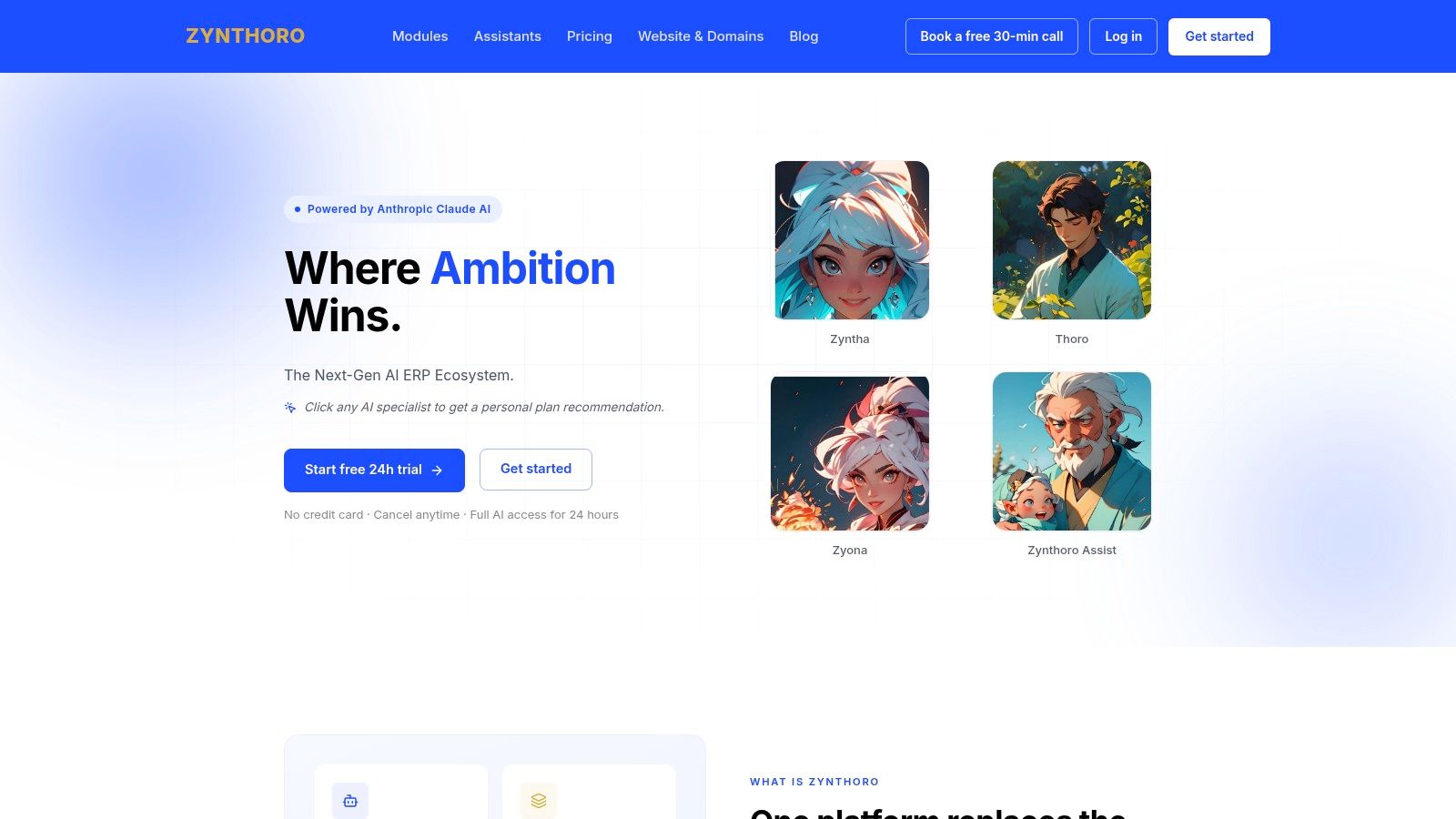
- Zyntha: Supports hands-free interaction when a user needs to record or retrieve project information without stopping field or production work.
- Thoro: Helps users work with operational information inside the platform rather than copying it into a separate AI chat.
- Zyona: Can support planning and coordination tasks where current project context is available.
- Zynthoro Assist: Provides another embedded route for updates and assistance across connected workflows.
A solo founder on a job site might use voice input to record progress, flag a customer decision, or update a task while their hands are occupied. The value isn't the novelty of voice. It's that the update can belong to the same project record used later for planning, time tracking, communication, and invoicing.
For a small operator comparing entry points, Kickstarter is listed as a one-time €79 option with lifetime access, 40% of Starter, 50 credits per month, AI Assistants, Planning & Time Tracking, Communication, and Canva Studio.
A short product walkthrough can help teams judge whether that embedded approach matches their working style:
Risks and Adoption Barriers You Should Know
The most common mistake is treating AI adoption as a software purchase instead of an operating-model change. Industry coverage reports that 70% of project professionals said their organization currently uses AI in projects, up from 36% in 2023, while another report found 88% of organizations using AI in at least one business function and 75% of knowledge workers using generative AI at work, as summarized in this AI project management statistics overview. The same source set says only 1% of project managers reported no current or planned AI use, which shows how quickly AI became a standard assumption in major markets.
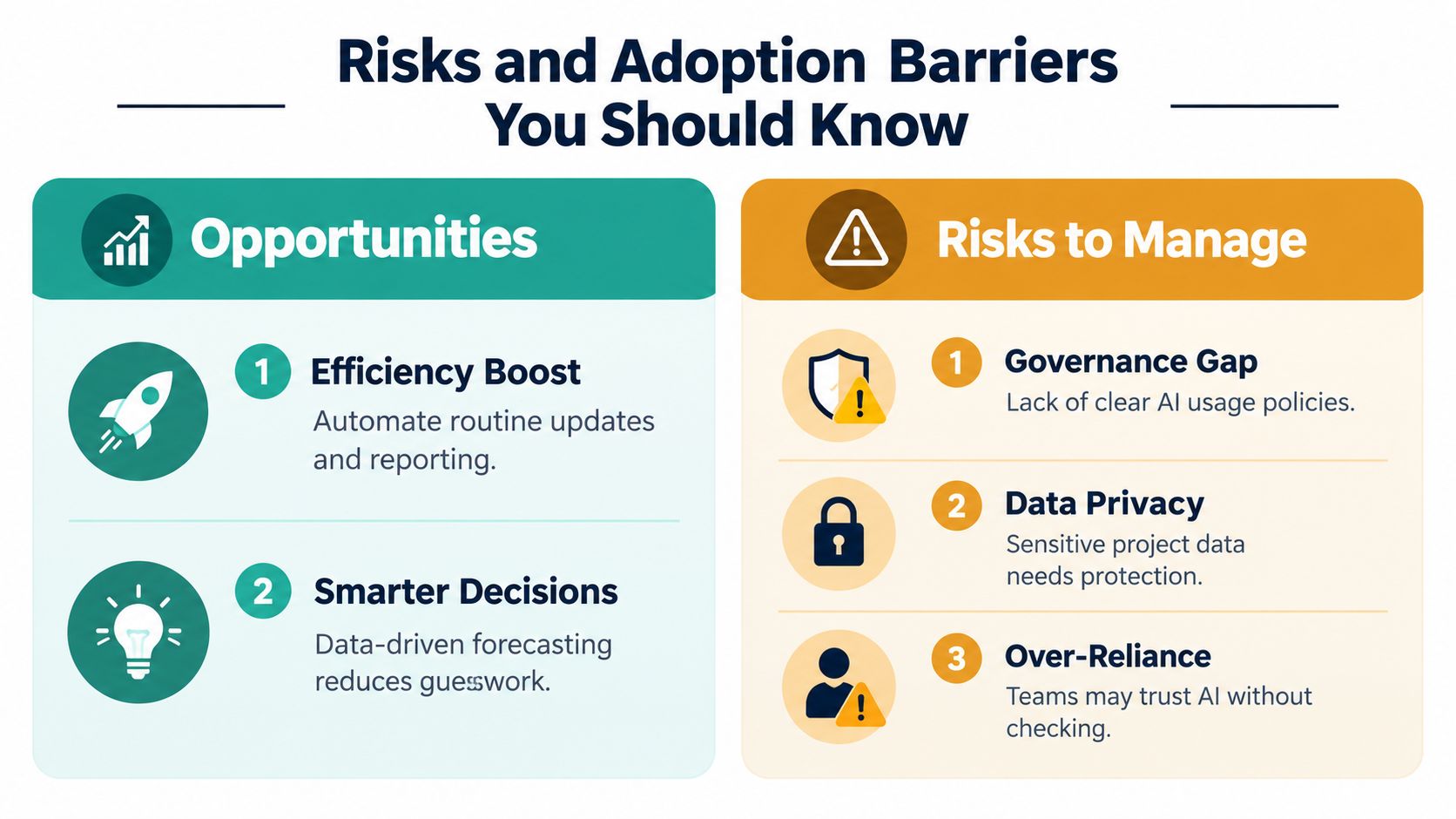
Readiness hasn't kept pace. Recent coverage reports that only 36% of companies have an AI governance policy and 49% of project professionals cite lack of training as a key adoption barrier, according to industry reporting on AI adoption and readiness.
Keep humans accountable for human decisions
AI can identify a late task, summarize a disagreement, or suggest a resource change. It's weaker at stakeholder management, negotiation, trust, and the emotional context behind a decision. A global chapter report notes that AI struggles with soft-skill areas such as stakeholder management, while more than 40% of respondents lacked AI training and over 50% were not strongly familiar with AI in project management, despite rising usage, as documented in the PMI global report on AI in project management.
Mitigation starts with simple rules:
- Define approval points: Require a person to approve client commitments, scope changes, budget decisions, and staffing changes.
- Protect sensitive data: Apply role-based access, audit trails, and clear rules for what information assistants can process.
- Train for verification: Teach staff to check source records, challenge unusual recommendations, and report inaccurate outputs.
- Start with contained workflows: Use AI first for summaries, reminders, and exception detection before granting broader authority.
Security deserves its own review. Teams concerned about autonomous actions and data exposure can use practical guidance on mitigating AI agent threats when designing permissions and review processes.
For SMEs considering a broader platform, Kickstarter 2 is listed as a one-time €149 option with lifetime access, 60% of Starter, 150 credits per month, Everything in K1, Finance & Invoicing, Sales, and an AI photo/video suite. The relevant question is whether the included capabilities match your governance and workflow requirements.
How to Adopt AI Project Management in Your SME
Start with an audit, not a demo. List every place where your team stores project information, including task boards, spreadsheets, chat channels, calendars, time tools, invoicing systems, customer records, and production documents. Then mark each repeated entry, manual export, delayed approval, and reconciliation step.
The audit should answer one practical question: where does project information lose context? A completed task that doesn't reach billing is a process gap. A sales order that doesn't inform delivery planning is a process gap. A production issue that doesn't update the client-facing project is a process gap.
Choose continuity over isolated features
Evaluate platforms by following a real project from sale to delivery and payment. Don't stop at the AI assistant screen. Ask whether the system can connect:
- Planning and time: Can people record work against the correct client, project, and task?
- Delivery and finance: Can completed work inform invoicing and reconciliation?
- Operations and production: Can work orders, materials, quality checks, and deadlines share context?
- People and capacity: Can managers understand assignments, leave, and available skills?
- Security and access: Are GDPR-ready controls, audit trails, and role-based permissions available for the way your team works?
Zynthoro is one example of an AI-native ERP approach, with connected modules spanning project management, time tracking, invoicing, HR, sales, operations, production, communication, and other business functions. Its embedded assistants are designed to work inside those workflows, rather than forcing users to move project data into a separate AI application.
Migrate in controlled stages
A phased migration lowers operational risk. Begin with one project type or team, clean the underlying records, define ownership, and document how updates should be captured. Keep the old system available for reference while the new workflow proves itself, but set a clear point at which duplicate entry stops.
Use a simple adoption checklist:
- Map the current stack: Record every system, owner, integration, and recurring manual transfer.
- Clean core data: Standardize clients, projects, tasks, users, suppliers, and billing references.
- Select a pilot: Choose work with visible coordination pain but manageable complexity.
- Set governance: Define permissions, approval points, acceptable AI use, and escalation routes.
- Train by task: Show staff how to capture updates, review suggestions, and correct records.
- Review outcomes: Compare administrative effort, visibility of blockers, billing continuity, and user confidence.
- Expand deliberately: Add teams and workflows only after the pilot produces dependable records.
This approach keeps AI adoption grounded in operating discipline. The platform can assist, but the business still needs clean data, clear ownership, and people willing to act on what the system reveals.
Building Your AI-Native Project Management Future
The strategic value of AI in project management doesn't come from adding a clever assistant to an already fragmented stack. It comes from connecting the records that describe how your business sells, plans, delivers, staffs, bills, and improves its work.
That connection changes the project manager's role. Instead of spending the day collecting updates, the manager can focus on exceptions, trade-offs, customer commitments, and conversations that require judgment. AI can summarize activity and identify patterns, but people remain responsible for decisions involving trust, scope, money, and relationships.
The market shift is already substantial. One source set reports that 70% of project professionals currently use AI in projects, compared with 36% in 2023, while broader workplace adoption has also accelerated, as documented in the industry statistics source. The operational question for an SME is no longer whether AI will appear somewhere in the workflow. It's whether the business will adopt it through controlled, connected processes or through another collection of uncoordinated tools.
Zynthoro represents the connected approach, bringing twelve business domains into an EU-hosted workspace with embedded Claude-powered assistants, GDPR-ready controls, role-based access, audit trails, and manufacturing features such as work orders, quality control, and lot traceability. That combination matters when project management must reflect the whole operation, not just a list of tasks.
Zynthoro brings project management, time tracking, finance, operations, sales, HR, communication, and production into one AI-native workspace for SMEs. Visit Zynthoro to see how connected records and embedded assistants can replace fragmented project workflows with a clearer operating system.